About Rhincodon typus Smith, 1828
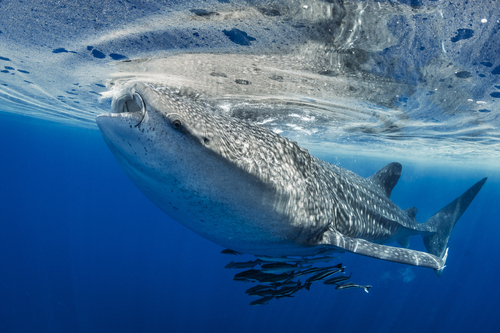
Whale sharks (Rhincodon typus Smith, 1828) have a broad, flattened head with a large mouth at the front of the head (rather than the underside, as in many other sharks) and two small eyes at the head’s front corners. Their mouths can grow exceptionally wide; one 12.1 m (39.7 ft) individual had a mouth 1.55 m (5.1 ft) across. A whale shark’s mouth holds over 300 rows of tiny teeth and 20 filter pads for filter feeding. Spiracles sit just behind the eyes, and the species has five large pairs of gills. Their skin is dark grey with a white belly, patterned with pale grey or white spots and stripes that are unique to each individual. Skin can reach up to 15 cm (5.9 in) thick, and is very hard and rough to the touch. Three prominent ridges run along each side of the body, starting above and behind the head and ending at the caudal peduncle. Whale sharks have two dorsal fins set relatively far back on the body, one pair of pectoral fins, one pair of pelvic fins, and a single medial anal fin. Their caudal fin is heterocercal, meaning it has a larger upper lobe than lower lobe. Dermal denticles with a different structure from those on the body cover the surface of the whale shark’s eyeballs. These denticles, along with the species’ ability to retract its eyes deep into their sockets, protect the eyes from damage. Evidence shows whale sharks can recover from major injuries and may regenerate small sections of their fins; their unique spot markings will even reform over previously wounded areas. A complete annotated genome of the whale shark was published in 2017. Rhodopsin, the light-sensing pigment found in the rod cells of the retina, is normally sensitive to green and used for vision in dim light. In whale sharks (and the bottom-dwelling cloudy catshark), two amino acid substitutions change this pigment to be more sensitive to blue light, which is the dominant wavelength in the deep ocean. One of these mutations makes rhodopsin vulnerable to higher temperatures. In humans, a similar mutation causes congenital stationary night blindness, because human body temperature triggers the pigment to decay. This pigment becomes unstable in shallow water, where temperatures are higher and a full spectrum of light is present. To avoid this instability, whale sharks deactivate the pigment when in shallow water, as an active pigment would interfere with full color vision. The pigment is activated again when the shark moves to the colder environment 2,000 meters below the surface. These mutations allow the shark to see well at both ends of its large vertical range. All cone opsins except LWS have been lost from the whale shark’s eyes. Whale sharks live in all tropical and warm-temperate seas. They are primarily pelagic, and can be found in both coastal and oceanic habitats. Data from tracking devices shows whale sharks use dynamic habitat utilization patterns, likely in response to prey availability. Whale sharks observed off the northeast Yucatan Peninsula typically swim inshore near the surface between sunrise and mid-afternoon, then perform regular vertical oscillations in oceanic waters during the afternoon and overnight. Around 95% of this oscillating period is spent in epipelagic depths (less than 200 metres / 660 ft), but whale sharks also make regular deep dives deeper than 500 metres (1,600 ft), often descending in short “stutter steps”, possibly for foraging. The deepest recorded whale shark dive reached 1,928 metres (6,325 ft). Whale sharks have been observed staying continuously at depths greater than 50 metres (160 ft) for three days or more. The whale shark is a migratory species with two distinct subpopulations: an Atlantic subpopulation ranging from Maine and the Azores to Cape Agulhas, South Africa, and an Indo-Pacific subpopulation which holds 75% of the entire global whale shark population. Whale sharks usually roam between 30°N and 35°S, where water temperatures are higher than 21 °C (70 °F), but individuals have been spotted as far north as the Bay of Fundy, Canada and the Sea of Okhotsk north of Japan, and as far south as Victoria, Australia. Seasonal feeding aggregations form at multiple coastal sites, including the Persian Gulf and Gulf of Oman, Ningaloo Reef in Western Australia, Darwin Island in the Galápagos, Quintana Roo in Mexico, Mafia Island of Pwani Region in Tanzania, Inhambane province in Mozambique, the Philippines, the area around Mahe in the Seychelles, the Gujarat and Kerala coasts of India, Taiwan, southern China and Qatar. In 2009, more than 400 whale sharks gathered off the Yucatan Coast, one of the largest recorded whale shark gatherings. Aggregations in this area are among the most reliable seasonal gatherings known for the species, with large numbers appearing in most years between May and September. Associated ecotourism has grown rapidly to unsustainable levels. Many details of whale shark growth, longevity, and reproduction remain poorly understood. Vertebral growth bands are used to estimate the species’ age, growth, and longevity, but for a long time there was uncertainty over whether these growth bands form annually or biannually. A 2020 study compared the ratio of Carbon-14 isotopes in whale shark vertebrae growth bands to nuclear testing events from the 1950s and 1960s, confirming that growth bands are laid down annually. The study estimated a 10 m (33 ft) female whale shark was 50 years old, and a 9.9 m (32 ft) male was 35 years old. Multiple studies examining growth bands and measuring wild whale sharks have estimated the species’ lifespan ranges from around 80 years up to around 130 years. Evidence indicates males grow faster than females in the earlier life stages, but ultimately reach a smaller maximum adult size. Whale sharks reach sexual maturity late. One study of free-swimming whale sharks estimated male age at maturity is around 25 years. Pupping has never been observed in whale sharks, but mating has been witnessed twice in St Helena. Mating in this species was filmed for the first time in 2019 off Ningaloo Reef, Australia, via airplane; the footage captured a larger male unsuccessfully attempting to mate with a smaller, immature female. The capture of a roughly 10.6 m (35 ft) pregnant female carrying around 300 pups in July 1996 confirmed that whale sharks are ovoviviparous. Eggs remain inside the female’s body, and females give birth to live young that measure 40 to 60 cm (16 to 24 in) long. Evidence suggests pups are not all born at once; instead, females retain sperm from a single mating and produce a steady stream of pups over an extended period. On 7 March 2009, marine scientists in the Philippines found what is believed to be the smallest recorded living whale shark specimen. This young shark measured only 38 cm (15 in), and was found with its tail tied to a stake at a beach in Pilar, Sorsogon, Philippines, before being released into the wild. Based on this discovery, some scientists no longer think this area is only a feeding ground, and suggest it may also be a birthing ground. Both young whale sharks and pregnant females have been sighted in the waters of St Helena in the South Atlantic Ocean, where many whale sharks can be seen during the summer. In an August 2019 report from Rappler, whale sharks were sighted during WWF Philippines’ photo identification activities in the first half of that year. A total of 168 sightings were recorded, 64 of which were re-sightings of previously recorded individuals. WWF noted that “very young whale shark juveniles” were identified among the 168 individuals sighted in the first half of 2019. Their presence suggests the Ticao Pass may be a pupping ground for whale sharks, which increases the area’s ecological significance. Large adult females, often pregnant, are seasonally present around the Galapagos Islands, which may have reproductive importance. A study conducted between 2011 and 2013 found that 91.5% of the whale sharks observed around Darwin Island were adult females.

