About Rhina ancylostoma Bloch & Schneider, 1801
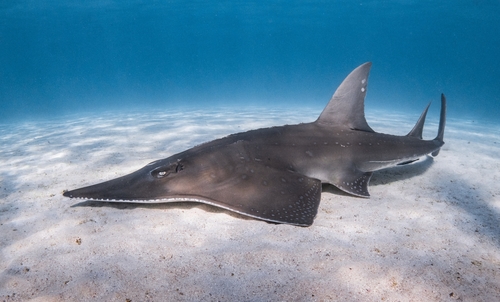
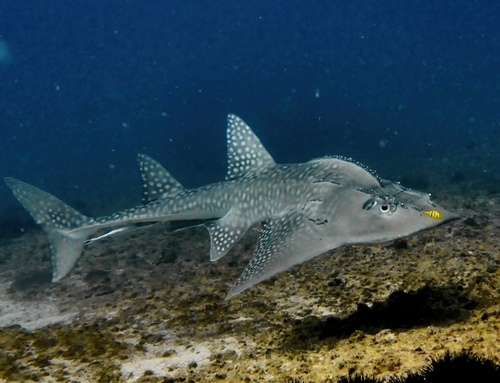
Rhina ancylostoma Bloch & Schneider, 1801 is a heavily built fish that grows to 2.7 m (8.9 ft) long and 135 kg (298 lb) in weight. It has a short, wide, flattened head with an evenly rounded snout; the front portion of the head, which holds medium-sized eyes and large spiracles, is clearly distinct from the body. Its long nostrils are oriented transversely, and have well-developed skin flaps on their anterior margins. The lower jaw has three protruding lobes that fit into matching depressions in the upper jaw. There are roughly 47 tooth rows in the upper jaw and 50 in the lower jaw, arranged in winding bands; the teeth are low and blunt, with ridges on the crown. Five pairs of ventral gill slits are located close to the lateral margins of the head.
The body is deepest in front of the two tall, falcate (sickle-shaped) dorsal fins. The first dorsal fin is about one-third larger than the second, and originates over the origins of the pelvic fins. The second dorsal fin sits midway between the first dorsal fin and the caudal fin. The broad, triangular pectoral fins have a deep indentation where their leading margins meet the head. Pelvic fins are much smaller than the pectoral fins, and the anal fin is absent. The tail is much longer than the body, and ends in a large, crescent-shaped caudal fin; the lower caudal fin lobe is more than half the length of the upper lobe.
The entire dorsal surface has a grainy texture from a dense covering of tiny dermal denticles. A thick ridge runs along the midline of the back, which holds a band of sharp, robust thorns. There are also one pair of thorn-bearing ridges in front of the eyes, a second pair running from above the eyes to behind the spiracles, and a third pair on the "shoulders". This species is bluish to brownish gray on its upper side, lightening toward the margins of the head and over the pectoral fins. Prominent white spots are scattered across the body and fins, there is a white-edged black marking above each pectoral fin, and two dark transverse bands on top of the head between the eyes. The underside is light gray to white. Young rays have more vivid coloring than adults; adult individuals are browner, with fainter patterning and proportionately smaller spots.
Though uncommon, Rhina ancylostoma is widely distributed in coastal tropical waters of the western Indo-Pacific. In the Indian Ocean, it occurs from KwaZulu-Natal in South Africa to the Red Sea (including the Seychelles), across the Indian subcontinent and Southeast Asia (including the Maldives), to Shark Bay in Western Australia. Its Pacific range extends north to Korea and southern Japan, east to New Guinea, and south to New South Wales. It is found at depths between 3 and 90 m (10 and 300 ft). This ray spends most of its time near the sea floor, but can occasionally be seen swimming in midwater. It prefers sandy or muddy habitats, and can also be found near rocky reefs, coral reefs and shipwrecks.
Rhina ancylostoma is a strong swimmer that propels itself with its tail, similarly to a shark. It is more active at night and is not known to be territorial. This species feeds mainly on demersal bony fishes such as croakers and crustaceans such as crabs and shrimp; it also consumes bivalves and cephalopods. Its bands of flattened teeth allow it to crush hard-shelled prey. Unlike earlier observations, a 2011 stable isotope study that examined two R. ancylostoma found the individuals had fed on pelagic rather than demersal animals. The tiger shark (Galeocerdo cuvier) is known to prey on Rhina ancylostoma. The ray is protected by the thorns on its head and back, and may ram perceived threats.
Reproduction in Rhina ancylostoma is viviparous; developing embryos are sustained to term by yolk. Adult females have two ovaries and two uterine horns. Litter size ranges from two to eleven pups, and newborns measure 45–51 cm (18–20 in) long. Males reach sexual maturity at lengths of 1.5–1.8 m (4.9–5.9 ft), while females reach sexual maturity at lengths over 1.8 m (5.9 ft). Females grow larger than males.