About Rheumaptera undulata (Linnaeus, 1758)
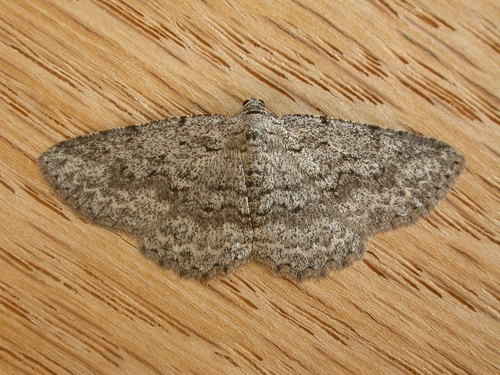
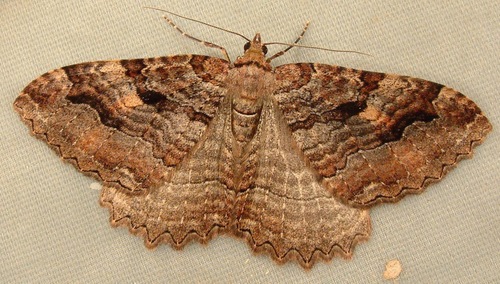
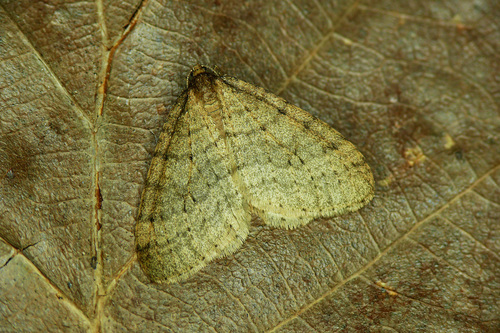
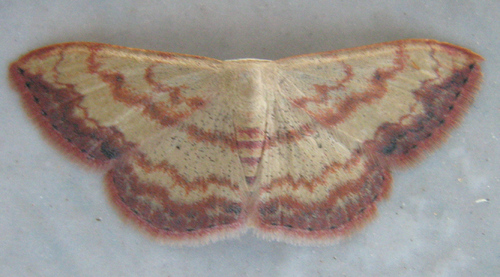
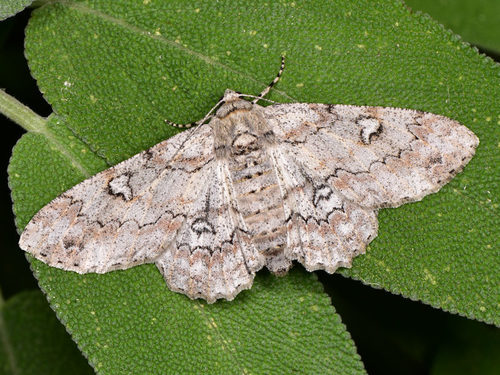
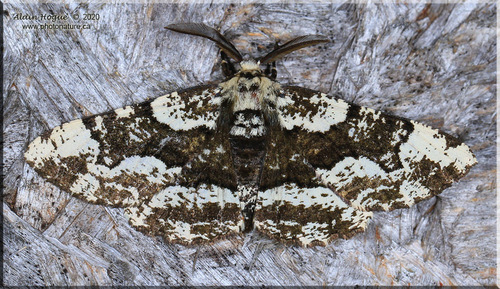
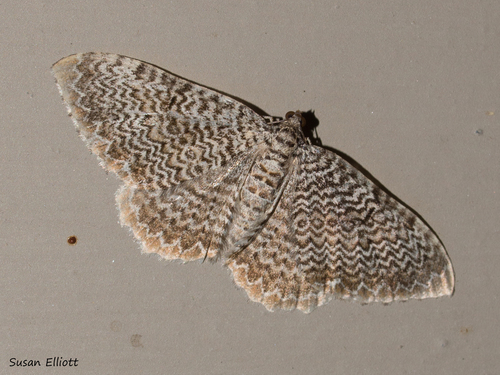
Rheumaptera undulata, commonly known as the scallop shell, is a moth species belonging to the family Geometridae. It was first formally described by Carl Linnaeus in the 10th edition of his work Systema Naturae, published in 1758. This species is distributed across most of the Palearctic realm and North America. Its wingspan measures between 25 and 30 mm. The forewings have a pale ground colour, marked by numerous evenly spaced, wavy, darker crosslines. The outer margin of the forewings is pale brown, with a scalloped fringe. The hindwings share a similar pattern to the forewings but are paler in colour. Mature larvae are relatively robust, and are nearly hairless aside from a few short white bristles. The larva spins silk to create a solitary shelter from a single leaf, or a small cluster of shoot tips. The larva's dorsum ranges from light to dark grey, with narrow white longitudinal stripes, while its venter is pale. In Europe, this species produces one generation per year, with adult moths active in flight from late May through August. Its primary habitats include open quarry forests, floodplain forests, bushy forest edges, gardens, and park landscapes. In the Alps, this moth can be found at elevations up to 1500 metres. The larvae feed on a range of host plants: birch species including Betula verrucosa and B. pubescens, Vaccinium species including V. myrtillus and V. uliginosum, willow species including Salix myrtilloides, S. caprea, S. aurita, S. cinerea, S. myrsinifolia and S. phylicifolia, as well as aspen (Populus tremula), Populus balsamifera, Berberis vulgaris, Ribes alpinum, Spiraea salicifolia, rowan (Sorbus aucuparia), Elaeagnus commutata and Myrica gale. Larvae can be found feeding in August and September, and the species overwinters in the pupal stage.