About Rhea pennata d'Orbigny, 1834
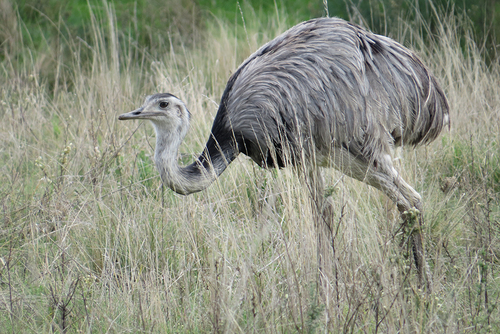
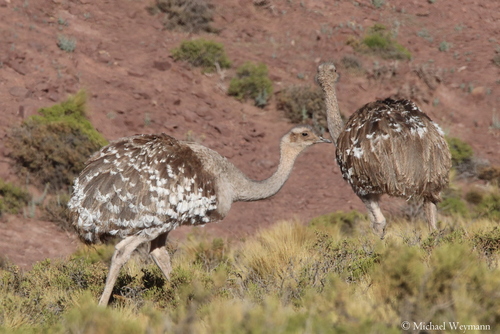
The lesser rhea (also called Darwin's rhea, scientific name Rhea pennata d'Orbigny, 1834) measures 90 to 100 cm (35–39 in) tall, 92 to 100 cm (36–39 in) in body length, and weighs 15 to 28.6 kg (33–63 lb). Like most ratites, it has a small head and a small bill, with the bill measuring 6.2 to 9.2 cm (2.4 to 3.6 in) long, along with long legs and a long neck. It has relatively larger wings than other ratites, which allows it to run particularly well; it can reach top speeds of 60 km/h (37 mph), letting it outrun predators. The sharp claws on its toes work as effective weapons. Its feathers do not have an aftershaft, which is similar to the feathers of ostriches. Its plumage is made up of brown and white spots, and the upper part of its tarsus is feathered. The tarsus is 28 to 32 cm (11 to 13 in) long, and has 18 horizontal plates on its front side. This species lives in open scrub areas of Patagonian grasslands and the Andean Altiplano plateau, across Argentina, Bolivia, Chile, and Peru. All subspecies of Rhea pennata prefer grasslands, brushlands, and marshland. The nominate subspecies prefers habitats at elevations below 1,500 m (4,900 ft), while other subspecies typically range from 3,000 to 4,500 m (9,800–14,800 ft), though they can occur locally as low as 1,220 m (4,000 ft) in the southern part of their range.