About Rhea americana (Linnaeus, 1758)
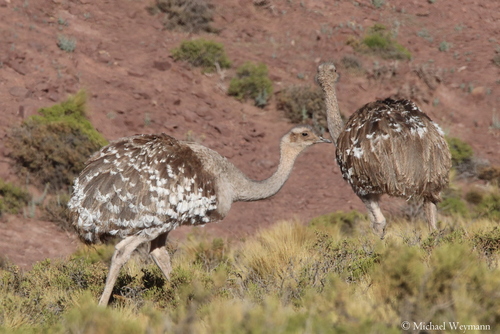
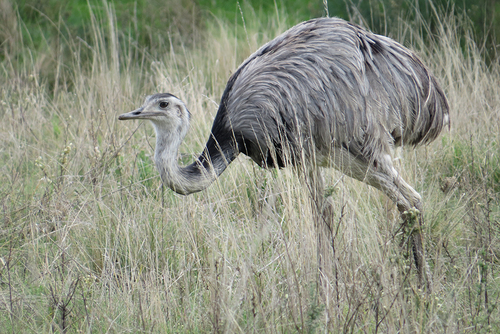
Adult greater rheas (Rhea americana) have an average weight of 20–27 kg (44–60 lb), an average total length from beak to tail of 127 to 140 cm (50 to 55 in), and a typical standing height (measured to the top of the head) of 1.5 m (4 ft 11 in), with a height range of 1.4 to 1.7 m (4 ft 7 in to 5 ft 7 in). Males are generally larger than females. While this species is called the "greater rhea" to distinguish it from the smaller lesser rhea, some body mass data shows both species average around 23 kg (51 lb) in weight. Even when average masses are similar, the greater rhea appears larger and taller thanks to its longer legs and neck; the lesser rhea is more compact, with a build more similar to that of an oversized, long-necked turkey. Other sources list a lower average weight of 16 kg (35 lb) for the lesser rhea. In some regions, male greater rheas can commonly weigh up to 35 kg (77 lb), and female greater rheas have been recorded weighing up to 30 kg (66 lb); both of these maximum weights are higher than the largest known mass recorded for the lesser rhea. Uncommonly, large male greater rheas can reach 40 kg (88 lb), stand almost 1.83 m (6.0 ft) tall, and measure over 150 cm (59 in) in length. The greater rhea has a fairly small head and small bill, with the bill measuring 8–10.4 cm (3.1–4.1 in) long. Its legs are long and strong, with a tarsus that measures between 33.5 and 37 cm (13.2 and 14.6 in) and bears 22 horizontal plates on its front. It has three toes, with no hind toe. The wings of the American rhea are rather long; the birds use these wings to maintain balance during tight turns when running, and also use them during courtship displays. Greater rheas have fluffy, tattered-looking plumage that is gray or brown, with high variation between individuals. The head, neck, rump, and thighs are all feathered. Typically, males have darker plumage than females. Leucistic individuals (with white body plumage and blue eyes) and albinos occur even in wild populations, particularly in Argentina. Hatchling greater rheas are gray with dark lengthwise stripes. The greater rhea is native to Argentina, Bolivia, Brazil, Paraguay, and Uruguay. Feral populations of the greater rhea also exist in Germany. This species lives in grasslands dominated by satintail (Imperata) and bahiagrass (Paspalum) species, as well as savanna, scrub forest, chaparral, and even desert and palustrine lands. It prefers areas with at least some tall vegetation. It is not found in the humid tropical forests of the Mata Atlântica or the planalto uplands along Brazil's coast, and its native range extends south to 40° latitude. Greater rheas prefer lower elevations, and seldom occur above 1,200 metres (3,900 ft). During the spring and summer breeding season, they stay close to water. The small non-native greater rhea population in Germany became established after one male and five females escaped from a farm in Groß Grönau, Schleswig-Holstein, in August 2000. These birds survived the winter and successfully bred in a habitat that closely resembled the species' native South American range. They eventually crossed the Wakenitz river and settled in Nordwestmecklenburg, in the area around, and particularly north of, the village of Thandorf. A biosurvey conducted in late 2012 found the population had grown to over 100 individuals and had become permanently established. By early 2017, the population reached approximately 220 birds. Because local farmers suffered crop harvest losses caused by the birds, some farmers received allowances to destroy the birds' eggs to slow population growth. At the end of 2017, the population was estimated at around 250 birds. At that time, the birds were classified as "domestic" and thus protected from hunting. By the autumn of 2018, the German population had grown to 566 individuals, and hunting of the birds was permitted; additionally, the population was further reduced by destroying eggs during the breeding season. After large winter flocks break up, greater rheas separate into three loose groups: single males, flocks of 2 to 15 females, and a large flock of yearlings. As winter approaches, males become more aggressive toward one another. Males then begin courting females by calling, lifting the front of their body while holding their neck straight and ruffling their plumage. They raise their wings and may run some distance while holding this posture, sometimes flapping their wings in a steady rhythm. After attracting females this way, a male will continue calling to a specific female, then walk alongside or in front of her with his wings spread and his head lowered. As the courtship display continues, the male becomes more intense and animated, waving his neck in figure-eight patterns. Once he attracts a first mate, he will copulate with her, then lead her to his nest. When the female is ready to lay her egg, the male is typically already at the nest and will act aggressively when the female approaches, covering the nest with his wings. He gradually relaxes, allowing her to crouch and lay the egg at the edge of the nest, after which the male will roll the egg into the nest. Greater rhea mating system is defined by simultaneous polygyny in males and serial polyandry in females. In practice, this means females move throughout the breeding season: they mate with a male, lay their eggs in his nest, then leave him to mate with another male. Males are sedentary, and handle all incubation, nest attendance, and care of hatchlings on their own. Recent research shows that some dominant males use subordinate males to help incubate and protect their eggs. When this arrangement occurs, the dominant male will find a second harem and start the breeding process again. Nests are used collectively by multiple females, and can hold up to 80 eggs laid by a dozen females. Each individual female lays a clutch of 5–10 eggs. The average clutch size is 26 eggs, laid by seven different females. Greater rhea eggs measure approximately 130 mm × 90 mm (5.1 in × 3.5 in) and weigh 600 g (21 oz) on average, which makes them less than half the size of an ostrich egg. When fresh, their shell is greenish-yellow, but it quickly fades to dull cream when exposed to light. The nest is a simple shallow, wide scrape dug in a hidden location. Males drag sticks, grass, and leaves into the area surrounding the nest, creating a firebreak-shaped clearing as wide as their neck can reach. The incubation period lasts 29–43 days. All eggs in a single nest hatch within 36 hours of each other, even though the eggs may have been laid up to two weeks apart. This coordinated hatching happens because when the first young are ready to hatch, they start making a call that resembles a pop-bottle rocket or even fireworks while they are still inside the egg, triggering synchronous hatching. Greater rheas are half-grown around three months after hatching, and reach sexual maturity by their 14th month.