About Rhapsa scotosialis Walker, 1865
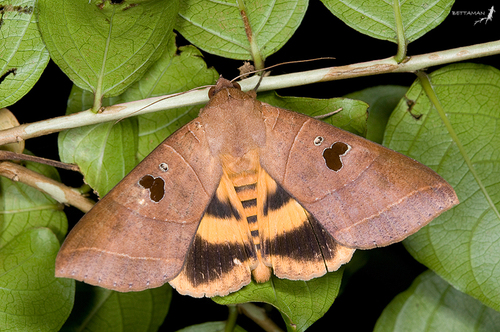
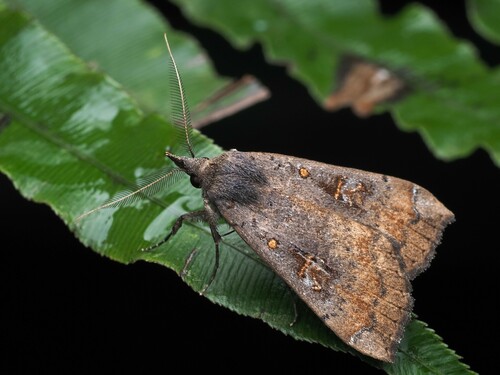
This species has the scientific name Rhapsa scotosialis Walker, 1865. Entomologist George Hudson provided the following description of its adult form: The wingspan of adult Rhapsa scotosialis is 1 and 3/8 inches. On the forewings, the costa is noticeably arched toward the apex, and the termen curves outward at its middle section. Males have pale brown forewings, while females have dark brown forewings. There are multiple faint black marks near the base of the forewings. The orbicular spot is very small, orange or pale grey with a black outline, and the claviform spot is absent. The reniform spot is conspicuous, with a heavily indented outer edge and a dull orange-red outline along its inner edge. A black blotch sits between the orbicular and reniform spots. Beyond the reniform spot, there is a curved transverse line that contains a series of tiny black dots, followed by a very prominent wavy transverse line that is shaded toward the wing base. There is a pale triangular area at the apex, and a row of small crescent-shaped dark brown markings along the termen. The forewing cilia are dark brown. The hindwings are greyish-ochreous, with a fairly faint line across the middle, followed by a broad shaded band. A series of small crescent-shaped markings runs along the hindwing termen, and the hindwing cilia are dark greyish-ochreous. Male antennae are strongly bipectinated. Females are noticeably darker overall, have fewer, less distinct markings, and lack the black blotch between the orbicular and reniform spots. Both males and females vary in how dark their coloration is, and newly emerged individuals may have a purplish tint on their forewings. Rhapsa scotosialis is endemic to New Zealand, and can be found across the whole country. It lives in native forest, and is one of the most common species of forest moth in New Zealand.