About Rhaphiolepis umbellata (Thunb.) Makino
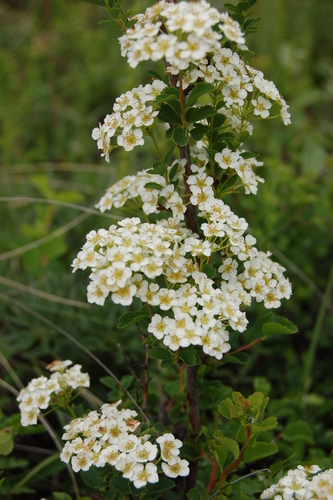
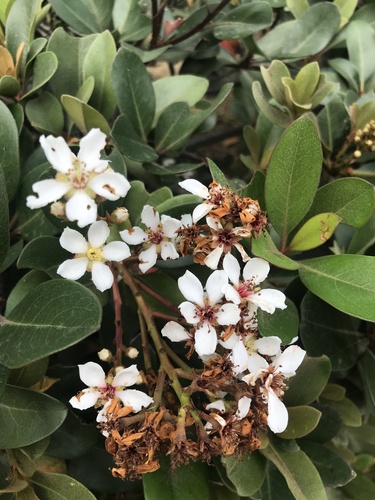
Rhaphiolepis umbellata (Thunb.) Makino, also commonly called Sexton's bride, is a flowering plant species in the Rosaceae family, native to Korea, Japan, and Taiwan. It is an evergreen shrub that grows to 1.5 meters (5 feet) in both height and width, with glossy oval leaves. In early summer, it produces scented white flowers that are sometimes tinged with pink. This plant has been awarded the Royal Horticultural Society's Award of Garden Merit.
In Japan, the species is called Sharinbai (車輪梅), and is known as Techigi on Amami Oshima. It has multiple uses: it is used as an astringent and a dyeing agent in Japan, and the bark contains (−)-catechin 7-O-β-d-glucopyranoside and (+)-catechin 5-O-β-d-glucopyranoside. It is used to produce dye for the highly valued Ōshima-tsumugi kimono: bark is chopped into chips and boiled for over 10 hours to make a tannin-rich decoction that dyes silk threads. After this initial dyeing, the threads are post-mordanted by dyeing in iron-rich paddy field mud until they turn black. Because it is resilient to drying and air pollution, Sharinbai is planted along roadsides. Its glossy evergreen foliage also makes it suitable for garden planting, as it tolerates frequent pruning well. Unlike most other Rhaphiolepis species, the fruits of Rhaphiolepis umbellata are inedible.