About Rhagoletis pomonella (Walsh, 1867)
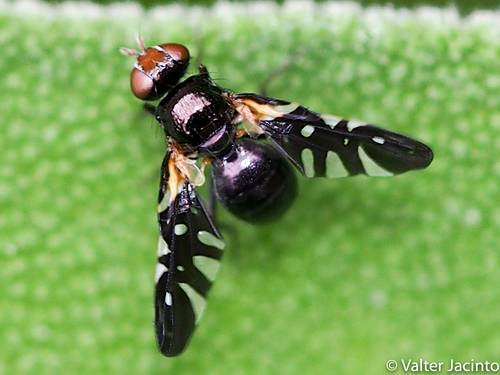
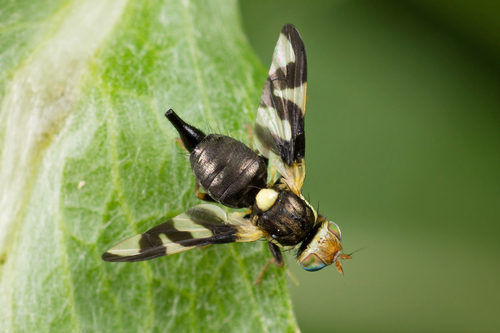
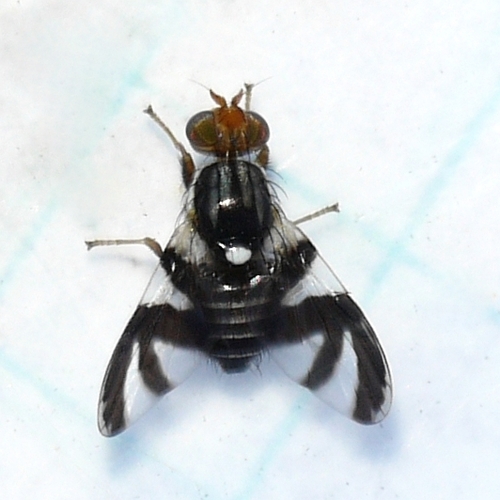
Rhagoletis pomonella, commonly known as the apple maggot, has distinct physical traits across all its life stages. When first laid inside fruit, its eggs are fusiform and pearly white; after a short period developing in the fruit, they turn cream-colored. Developing larvae are clearly visible through the translucent egg membrane. Mature larvae are white or cream-colored; if a larva feeds on green fruit pulp near the fruit skin, the green color shows through its own body wall. Fully grown larvae measure 7 to 8.5 mm in length and 1.75 to 2 mm in width. Pupation occurs inside the discarded larval skin, after the maggot shortens its body and becomes inactive. The developing pupa is initially light yellow, darkens to yellow-brown within a few hours, and continues to darken as it matures. Pupae are elongated oval in shape, measuring 4 to 5 mm in length and 2 to 2.5 mm in width. Adult female Rhagoletis pomonella are shiny black with white markings, averaging 6.25 mm in length with an average wingspan of 12 mm. They have green eyes and one white stripe on each side of the thorax. Their abdomen is shiny black with four evenly spaced uniform white bands. When not in use, the ovipositor is fully retracted into the abdomen; the ovipositor itself is horn-like, hard, and composed of chitin. Adult males look very similar to females but are smaller, averaging 4 to 5 mm in total length. The main visible difference is in the abdomen: only five of the seven abdominal segments are visible, as the sixth and seventh are retracted beneath the fifth. The sixth and seventh segments hold a chitinous framework that supports a long, coiled spiraling chitinous penis, which ends in a spiral brush covered in numerous stiff hairs. This species is widespread across North America, and is endemic only to the eastern United States. The range of the apple-feeding host race falls entirely within the range of the hawthorn-feeding host race, covering the northeastern and midwestern United States as well as eastern Canada. The species has been recorded as far south as Florida. The apple maggot was first officially recorded in a Portland, Oregon backyard tree in 1979. California border quarantine inspection records have intercepted infested fruit carrying apple maggots at border stations since approximately 1950. A specimen of apple maggot misidentified as the snowberry maggot Rhagoletis zephyria was found in the Oregon Department of Agriculture (ODA) tephritid fly collection; this specimen was originally collected in 1951 in Rowena, Oregon. The ODA ran a distribution survey for the apple maggot in 1980, and traps placed in southwestern Washington confirmed apple maggot populations in and around Vancouver, Washington, a suburb of Portland, Oregon. Since these early records, the apple maggot has spread to the Pacific Northwest, including Washington, Oregon, and northern California. It is believed to have spread to this region via contaminated commercial apples, and was most likely accidentally introduced to the western United States multiple times over the past few decades. This theory is supported by the lack of recorded Rhagoletis pomonella infestations on native Crataegus douglasii hawthorns in Washington, Oregon, and Idaho, which suggests the species is not native to hawthorns in these regions. Confirmed sightings of Rhagoletis pomonella have also been recorded from southern Utah, New Mexico, the Sierra Madre Oriental Mountains, and the Altiplano central highlands of Mexico. The original ancestral host of the apple maggot was wild hawthorn (Crataegus spp.). In the mid-1800s, after cultivated apples (Malus spp.) were introduced to North America, Rhagoletis pomonella evolved to exploit this new host plant. Apple maggots can also develop in the fruits of peach, pear, cherry, plum, chokeberry, cranberry, dogwood, and the Japanese roses Rosa rugosa and Rosa carolina. Apple maggots are not usually considered a serious pest of plums, cherries, or pears; larvae have been found developing in pears, but adult flies have not been recorded from this host.