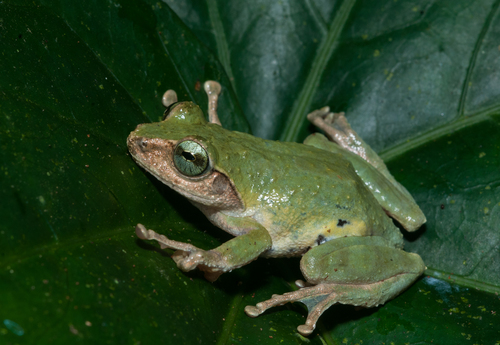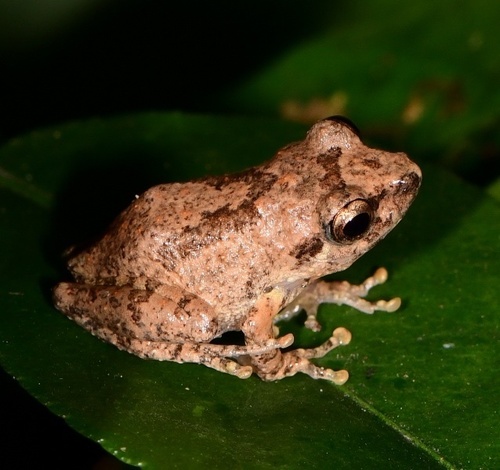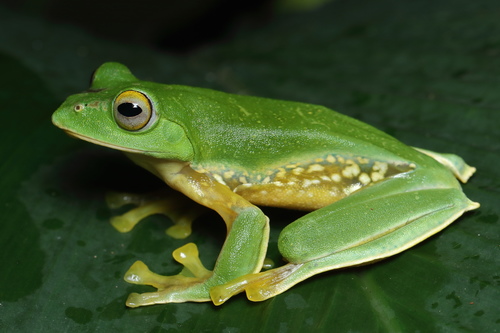
About Rhacophorus pseudomalabaricus Vasudevan & Dutta, 2000
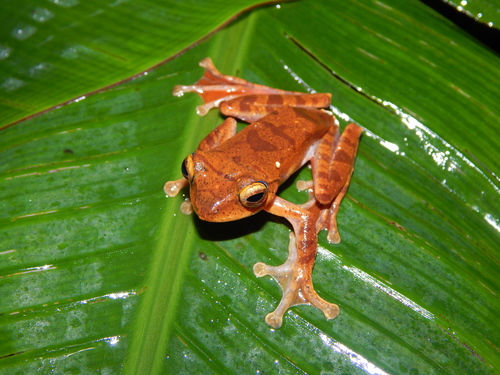
Description: Adult male Rhacophorus pseudomalabaricus measure 47–54 mm (1.9–2.1 in) in snout–vent length, while adult females measure 66–72 mm (2.6–2.8 in). This species has protruding eyes and a distinct supra-tympanic fold. Its fingers and toes are extensively webbed, with webbing ranging in color from light yellow to red-orange. Juveniles have a distinct black zebra-like pattern that fades in adults, where it comes to resemble the venation of a leaf; the body background color is green. Researchers note this is the only species in the genus Rhacophorus that has this leaf-resembling pattern, and they speculate it functions as camouflage. Habitat and conservation: Rhacophorus pseudomalabaricus has been recorded in several locations: tropical moist evergreen forest, secondary forests on the edge of an abandoned cardamom plantation, a marshy area next to a perennial stream outside a cardamom plantation, and near an artificial water hole between evergreen forest and a tea plantation. Specimens have been found both in lower canopy and understorey vegetation, and on the ground. This species occurs at elevations between 955–1,430 m (3,133–4,692 ft) above sea level. Researchers note that elevation is an easy characteristic to distinguish this species from Rhacophorus malabaricus, as R. malabaricus lives at elevations much closer to sea level. Reproduction occurs on vegetation that overhangs marshy areas, ponds, and streams. The male's advertisement call follows the pattern "trrr tik tik tik tik trrrr." Amplexus for this species can last one hour. Females use their hind legs and fluid from a gland near the cloaca to create a foam nest, where they deposit eggs that are subsequently fertilized by the male. After egg deposition, the female covers the foam nest with leaves or grass using her front limbs. This species is confirmed to live in at least two protected areas: Indira Gandhi National Park and Parambikulam Tiger Reserve. Outside of protected areas, it is threatened by habitat loss from forest conversion to other land uses, timber extraction, and conversion of forest to pastureland. Many local people hold negative views of this frog: cardamom farmers believe the frog eats cardamom fruit, and thus consider it an agricultural pest. Researchers note that there is currently no evidence that either confirms or disproves this belief. Some farmers pay other people to catch and kill this frog. There is also a local belief that this frog is a bad omen, particularly for pregnant women. Additionally, this frog is captured illegally for the pet trade.