About Rhacophorus kio Ohler & Delorme, 2006
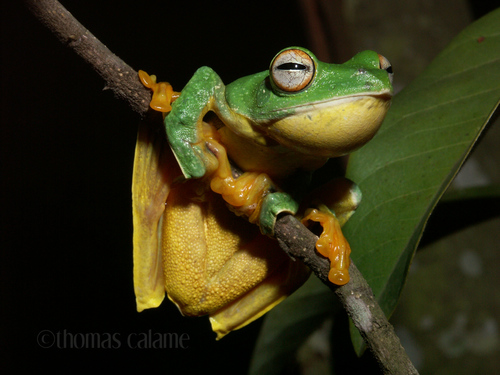
The tadpoles of Rhacophorus kio are light olive with a white abdomen. Their fins are mostly colorless, with lighter grey edges near the tail. Tadpole bodies are oval-shaped, widest around the gill region, and have a rounded snout. Fully developed late-stage tadpoles measure 43 to 52 mm in total length. Adult Rhacophorus kio range from 58 to 79 mm in size; this larger adult size distinguishes R. kio from the related species Rhacophorus reinwardtii. The dorsal side of adult R. kio is grass green with darker green patches, marked with small white spots. The lower flanks are dark brown and marked with yellow spots. The ventral side of the adult frog is solid yellow. The thigh is grass green, with an orange-yellow posterior region. A large, distinct black spot is clearly visible in the armpit region. Both webbed toes and webbed fingers of R. kio are orange-yellow, with a small black spot between each toe and each finger. Rhacophorus kio is native to the rainforests of Southeast Asia, where it occurs at elevations between 200 m and 1,800 m above sea level. It inhabits the closed canopy of primary and secondary evergreen rainforests. One population of R. kio was observed at 57 m high in the rainforest canopy of southwest China, an unexpected find because the drier canopy top is generally considered unsuitable for amphibians, which typically prefer the protected lower canopy that shelters them from weather and predators. Researchers hypothesize the frogs occur at the canopy top to access the insects and other potential food sources present at that height. R. kio is distributed across China, Laos, Thailand, and Vietnam. Within China, it is found in Guangdong and Yunnan provinces. In Laos, it occurs in Bokeo, Khammouan, and Phongsaly provinces. In Thailand, it has been recorded in Chiang Mai and Tak provinces. In Vietnam, it can be found in Gia Lai, Ha Tinh, Lao Cai, Quang Binh, and Thanh Hoa provinces. While the species has a wide distribution across much of Southeast Asia, most of this area is not suitable habitat, as hills and mountains do not provide good breeding locations for R. kio. Instead, the species depends on undisturbed canopy, marshes, and ponds within primary rainforests, habitats that are currently threatened by ongoing deforestation across Asia. Reproduction for R. kio takes place from April to July. Males call from tree canopies located above breeding pools to attract mates. During amplexus, the female releases eggs and mucus, while the male releases sperm. Both frogs kick their hindlegs to mix the eggs, mucus, and sperm into a sticky foam. After the foam is created, the male leaves. The female then uses her hindlegs to gather nearby leaves and wrap the foam mass in these leaves, holding this position for roughly two minutes. She repeats this leaf-gathering and wrapping process three times to create an ellipsoid leaf structure that encloses the entire egg clutch. After holding the completed structure for 20 minutes, the female departs. The foam surrounding the eggs eventually hardens into a protective crust. Once embryos mature and hatch, the tadpoles drop out of the nest structure into the pool below, where they continue developing into adult frogs. Eggs of R. kio are often preyed upon by larvae of Caiusa, a genus of blow flies in the family Calliphoridae that infests the egg masses of many local frog species. The leafy outer structure of R. kio nests works to hide the eggs from this and other threats.