About Rhacochilus toxotes Agassiz, 1854
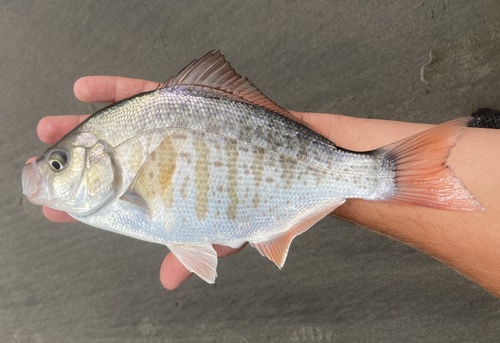
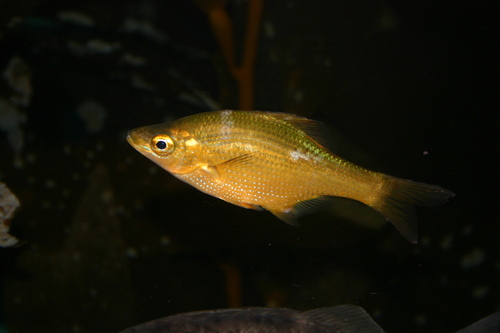
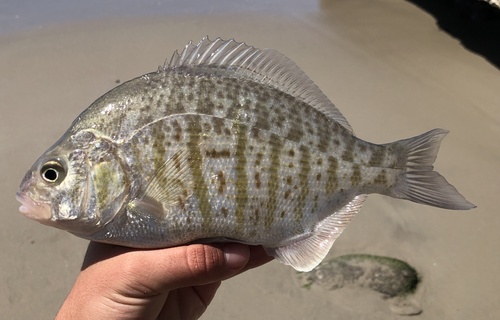
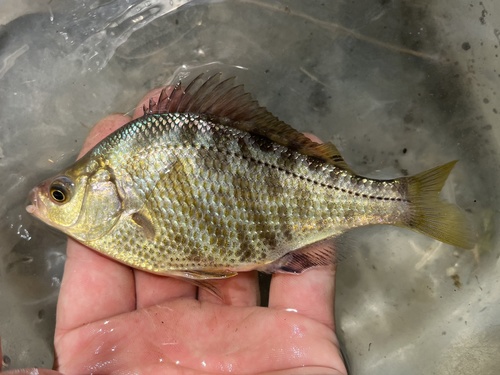
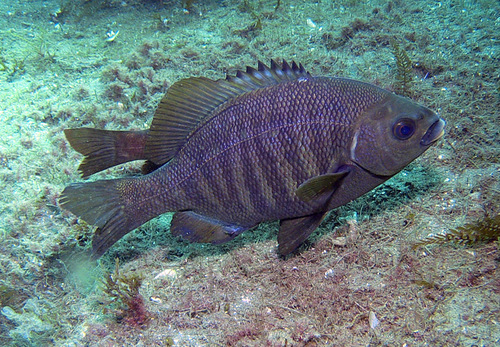
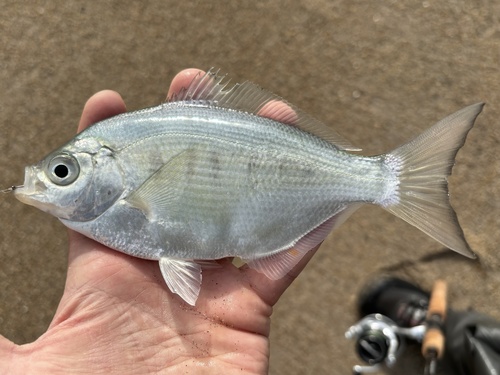
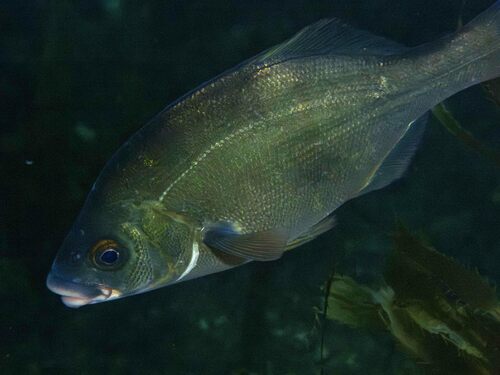
Rhacochilus toxotes, commonly known as rubberlip surfperch, belongs to the surfperch family Embiotocidae. Like other members of this family, it has a laterally compressed, deep-bodied shape. As its common name suggests, this species is distinct for its large, fleshy lips, which are white or pink in color. It can also be identified by a unique black or darkened band on each side of its body, which can extend from the dorsal fin to the anal fin, though not all individual rubberlip surfperch have this marking. The species' overall body coloration is typically brown-brass, but it can also appear closer to white, chrome, or even green-grey; juvenile individuals are usually more pinkish-tan. Rubberlip surfperch have a prominent lateral line, and their bodies are covered in large scales. Their pectoral fins are most often the same color as their body, but may also be yellow or grey, and the lower portion of the operculum and the jaw are white. To distinguish this species from the closely related pile surfperch (Rhacochilus vacca) – which also has a black body band – note that pile surfperch have much taller first rays on their soft dorsal fin, less prominent fleshy lips, and a small white dot at the top of their black band that rubberlip surfperch do not have. Rubberlip surfperch are the largest surfperch species by weight, reaching a maximum weight of 2.25 kg (5.0 lb), and the second largest surfperch by total length, growing to 47 cm (18.5 in) TL; only the barred surfperch Amphistichus argenteus grows to a longer length. Like all surfperch, rubberlip surfperch are viviparous, meaning they give birth to fully developed live young. On average, females give birth to 20 developed young that measure approximately 9 cm (3.5 in) long. Females are fertilized internally by males during the summer, when algal growth and overall food abundance are high. Individuals can live a maximum of 7 to 10 years. Rubberlip surfperch are distributed from Cabo Thurloe at the tip of Baja California Sur north to Mendocino County in Northern California, and also occur around Guadalupe Island off Baja California. They are less common in waters north of Monterey Bay. This species is most commonly found near rocky reefs, kelp forests and kelp beds, both exposed and protected rocky shores, bays, tidepools, and near man-made structures such as piers. It occurs at depths ranging from the surf zone down to 50 m (160 ft), and has been observed as deep as 80 m (260 ft). It prefers to inhabit rocky areas that have abundant aquatic vegetation and prey. It is occasionally seen schooling with other surfperch species including pile surfperch and striped surfperch (Embiotoca lateralis). Rubberlip surfperch feed primarily at night, preying on thin-shelled invertebrates and crustaceans. They use their large fleshy lips to help sense food while digging through sediment.