About Rhabdotorrhinus corrugatus (Temminck, 1832)
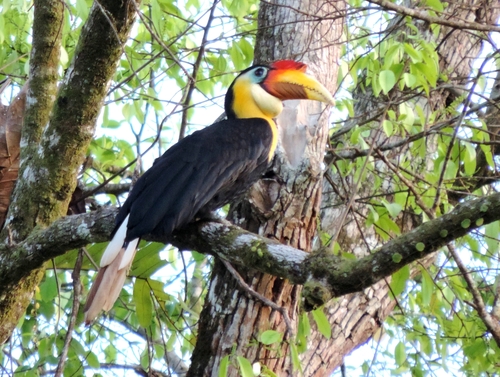
The wrinkled hornbill, also called the Sunda wrinkled hornbill (Rhabdotorrhinus corrugatus), is a medium-large hornbill that inhabits forests in the Thai-Malay Peninsula, Sumatra, and Borneo. It is roughly 70 cm long, with a very large bill that is fused to the skull. It has mostly black plumage, a blue eye-ring, and a tail with a broad white or rufous tip. Males and females have different head and bill patterns. Males have bright yellow feathers on the auriculars, cheeks, throat, neck sides, and chest; these areas are black in females, with the exception of a blue throat. The male’s bill is yellow, with a red base and red casque, and a brownish basal half on the lower mandible. The female’s bill and casque are almost entirely yellow. This is a forest-dwelling species that feeds mainly on fruit, such as figs, though it also eats small animals including frogs and insects. Wrinkled hornbills do not drink, and instead get all the water they need from their food. Their call is a harsh "Kak-kak", or a deep "Row-wow" that can be heard for miles. These birds are monogamous and pair for life. They nest in natural tree holes. The female plasters over the nest entrance with mud and droppings, leaving only a small opening that is too small for the nesting female and her chicks to exit through. The female and chicks are fed exclusively by the male, who regurgitates food for them. When the chicks are ready after several months, the female breaks out of the nest. The first successful captive breeding of wrinkled hornbills occurred in 1988. Heavy deforestation of their forest habitat led to this species being uplisted from Near Threatened to Endangered on the IUCN Red List in 2018.