About Rhabdothamnus solandri A.Cunn.
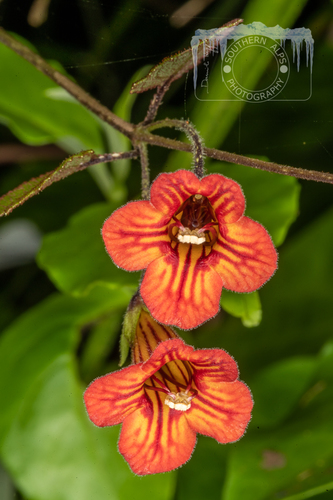
Rhabdothamnus solandri A.Cunn. is a small shrub in the family Gesneriaceae that is endemic to New Zealand. It is the only species in the genus Rhabdothamnus, and also the only native Gesneriaceae member in New Zealand. Its common names include New Zealand gloxinia, and it has three Māori common names: taurepo, mātātā, and waiū-atua. This species occurs across New Zealand's North Island, with sparser populations in the southern part of the island, as well as on the island's offshore islands. It grows in a range of habitats including forests, areas near streams, and river or stream banks. It grows as a shrub that reaches up to 2 metres in height. It bears distinctive trumpet-shaped flowers of moderate size. The flowers are typically 2–2.5 centimetres long, and can reach up to 4 centimetres in length. Flower colour is most often orange, but may also be brick-red, yellow, purple or pink. The flowers have longitudinal stripes formed by 12–14, or even up to 20, red or dark orange veins. This species flowers year-round, with peak flowering occurring between October and February. Its flowers are primarily pollinated by three New Zealand native birds: the bellbird, tūī, and stitchbird. The silvereye, a bird species that only immigrated to New Zealand in the 19th century and has not co-evolved with this or other New Zealand native plants, has a beak too short to properly pollinate R. solandri flowers. Instead, it sometimes tears through the sides of the flowers to steal nectar. Bellbirds and stitchbirds became locally extinct in the upper North Island around 1870, and tūī have retreated to higher forest canopies and prefer the more nectar-rich exotic flowers found in the region. These changes have caused a long-term reduction in reproduction for this shrub, which requires pollination to produce seeds. Because R. solandri is a slow-growing, long-lived plant, its current populations still persist. Due to extinction debt, the future extinction of this shrub is nearly guaranteed.