About Rhabdosargus sarba (Forsskål, 1775)
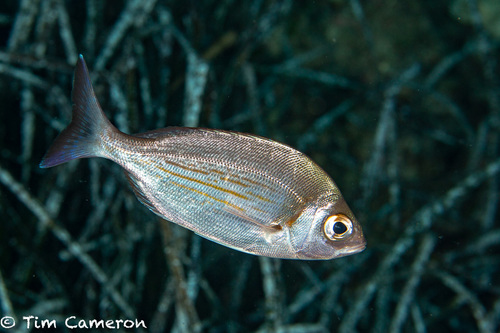
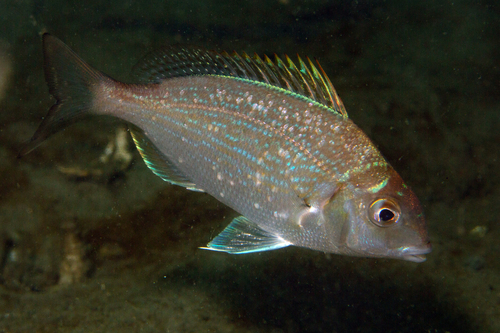
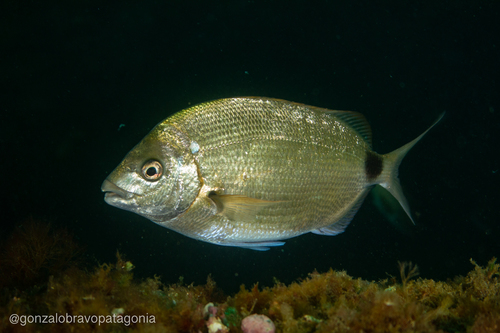
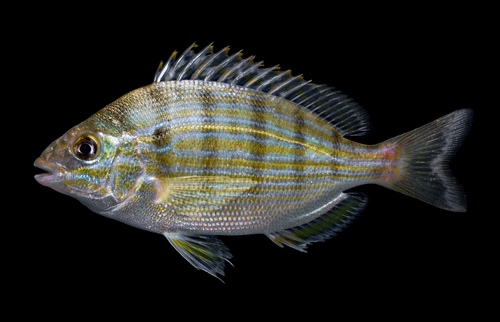
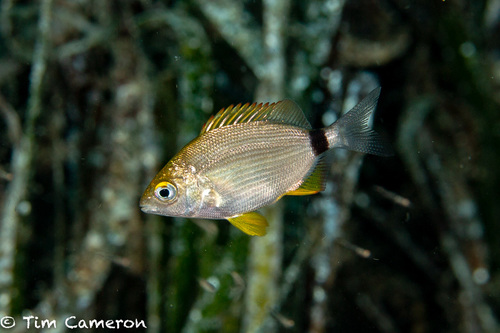
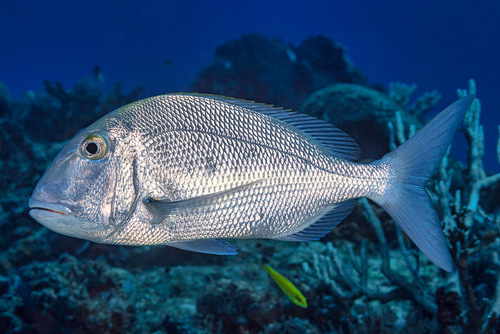
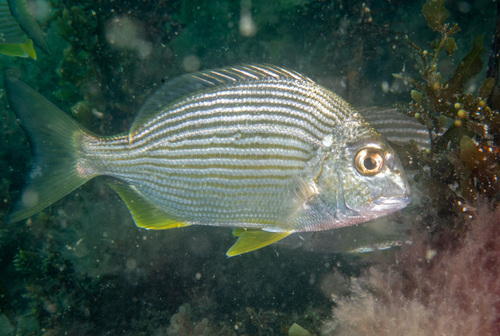
Rhabdosargus sarba has a deep, compressed body; its body depth fits into the fish's standard length 2 to 2.3 times. It has a large head, with a convex dorsal profile that is most strongly arched between the snout and the origin of the dorsal fin. Its moderately sized eyes are relatively smaller in adult individuals. The dorsal fin is supported by 11 spines and 12 or 13 soft rays, while the anal fin is supported by 3 spines and 11 soft rays. The largest molar-like teeth of this species are located at the rear of the third outer row. The overall body colour of Rhabdosargus sarba is grey with a silvery-gold tint, the ventral (belly) surface is silvery-white, and thin yellowish to golden horizontal stripes run along its flanks. Its pelvic and anal fins are coloured yellowish to brownish-yellow. The maximum published total length for this species is 80 cm (31 in), though 45 cm (18 in) is more typical, and the maximum published weight is 12 kg (26 lb).
Rhabdosargus sarba has a wide distribution across the Indo-Pacific, ranging from the Red Sea and the eastern coast of Africa south to the southern coast of South Africa, east across the Indian Ocean into the Pacific Ocean as far as the South China Sea and Japan, and south to Australia. In Australia, it occurs along the Western Australian coast from Bremer Bay to Exmouth, and along the east coast from Townsville, Queensland south to Mallacoota, Victoria. There is a single recorded sighting of this species in the Mediterranean off Syria, which is thought to be a Lessepsian migrant that entered from the Red Sea via the Suez Canal. This fish, commonly called tarwhine, inhabits waters at depths between 0 and 60 m (0 and 197 ft). Juveniles and young fish are found in estuaries, while adults move out into deeper coastal waters.