About Retropinna semoni (Weber, 1895)
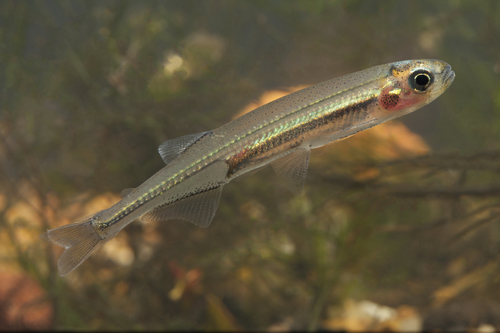
Retropinna semoni is a small silvery fish that reaches a maximum total length of 75 mm in wild populations, very occasionally growing up to 100 mm. Wild specimens in Coopers Creek usually only reach 50 mm, but captively raised individuals easily exceed 100 mm and live longer than wild fish. Wild individuals have a clear to purple-olive back, translucent sides with a silver streak and sometimes orange highlights, and entirely colorless fins. This species is endemic to Australia, and is widely distributed across coastal drainages of southeastern mainland Australia. Its range extends from the southeastern corner of South Australia, through Victoria and New South Wales, to the Fitzroy River in southeastern Queensland. It is also common throughout the Murray River and its tributaries, and occurs up the Darling River as far upstream as Wilcannia. Isolated populations exist in Coopers Creek, which drains into Lake Eyre, along with several smaller isolated populations in northwestern New South Wales and southern Queensland. Recent genetic research indicates that what is currently considered Retropinna semoni (Australian smelt) stocks are actually made up of 5 highly genetically distinct, still undescribed species (Hammer et al., 2007). This pelagic species is most often found in large schools that can number thousands of individuals, and it prefers slow-moving or still water. It is commonly found in billabongs, dams, lakes across a range of salinity levels, and in the lower reaches of rivers and streams. While there have been some reports of diadromous populations, the species usually completes its entire life cycle in freshwater. It forms shoals near the surface, around aquatic plant cover and woody debris. It spawns in spring when water temperatures rise above 15 °C. Its eggs are demersal, adhesive, spherical and transparent. They measure approximately 0.8 mm in diameter, and swell to 1 mm when hardened in water. After laying, eggs fall to the stream bottom and stick to instream debris, vegetation and the substrate. Females lay between 100 and 1000 eggs per spawning event. Eggs hatch after approximately 9 to 10 days, and newly hatched larvae have a total length of around 4.5 to 5 mm.

