About Rena humilis Baird & Girard, 1853
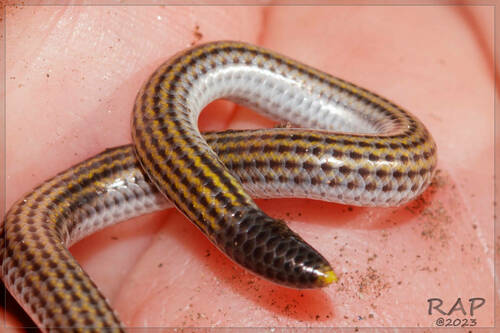
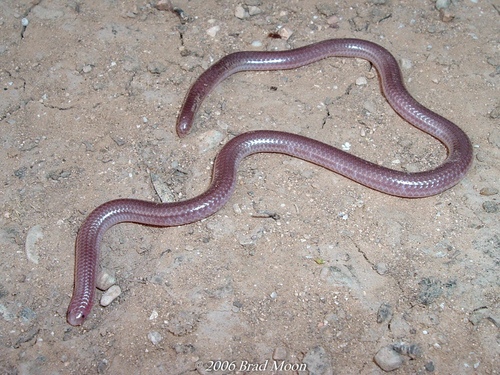
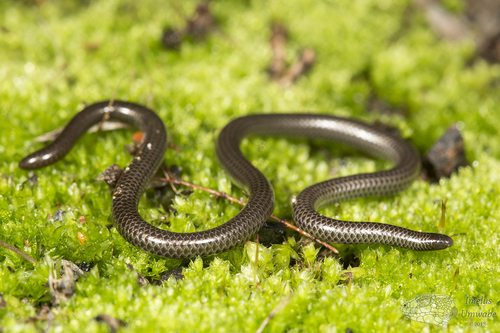
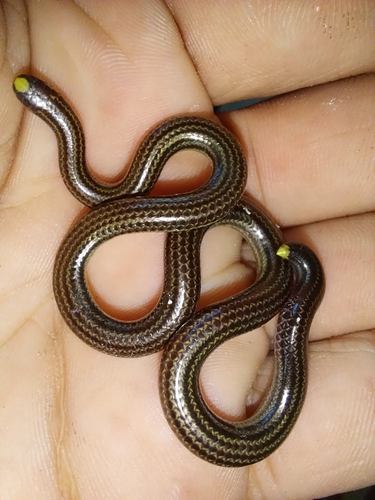
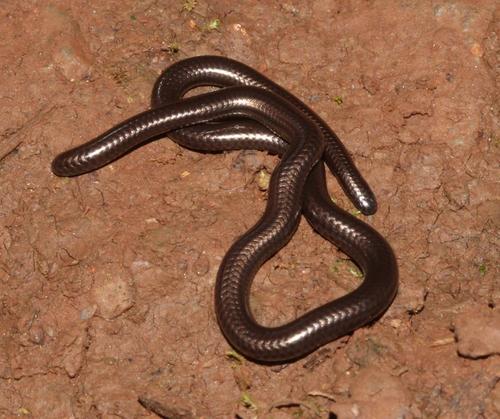
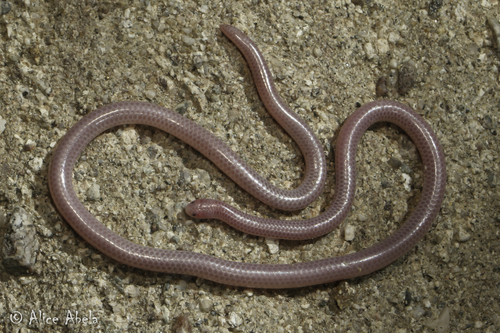
Rena humilis (also referenced as L. humilis in the original text), like most species in the family Leptotyphlopidae, resembles a long earthworm. It lives underground in burrows, and since it has no use for vision, its eyes are mostly vestigial. This species, commonly called the western blind snake or western threadsnake, is pink, purple, or silvery-brown, shiny, wormlike, cylindrical, blunt at both ends, and has light-detecting black eyespots. It has a thick skull that allows it to burrow, and a spine at the end of its tail that it uses for leverage. It is usually less than 30 cm (12 in) in total length including the tail, and as thin as an earthworm. This species and other blind snakes are fluorescent under low frequency ultraviolet (black) light. On the top of the head, between the ocular scales, R. humilis has only one scale, while L. dulcis has three scales. R. humilis is found in the southwestern United States and northern Mexico. In the United States, its range extends from southwestern and Trans-Pecos Texas west through southern and central Arizona, southern Nevada, southwestern Utah, and southern California. In Mexico, it can be found in the states of Baja California, Sonora, Sinaloa, Nayarit, Jalisco, Colima, Chihuahua, Durango, Coahuila, Tamaulipas, and San Luis Potosí. Its original type locality is recorded as "Valliecitas, Cal." This type locality was first restricted by Klauber in 1931 to "vicinity of Vallecito, eastern San Diego County, California," then restricted further by Brattstrom in 1953 to "the Upper Sonoran Life Zone of the Vallecito area". R. humilis lives underground, sometimes reaching depths of 20 metres (66 ft), and is known to enter ant and termite nests. Its diet consists mostly of insects, their larvae, and their eggs. It occurs in deserts and scrub where soil is loose enough to burrow. The western threadsnake often forages inside ant nests, eating ant larvae and termites. Studies by Bateman et al. (2010) indicate that chemical secretions on its body surface help suppress ant aggression, letting it move through ant colonies without being harmed.