About Rena dulcis Baird & Girard, 1853
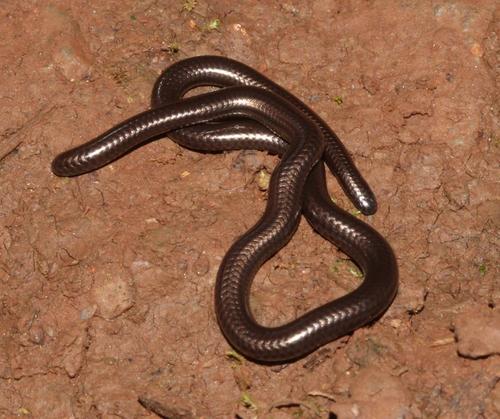
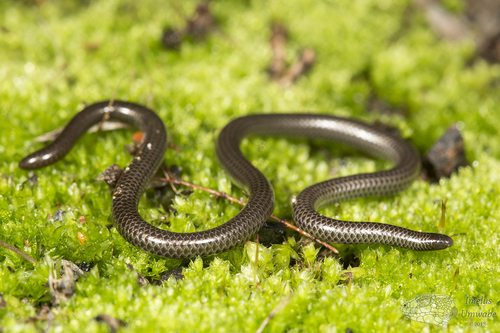
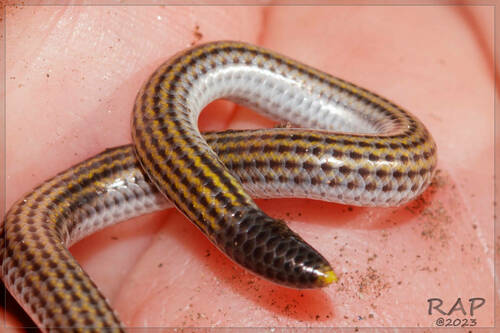
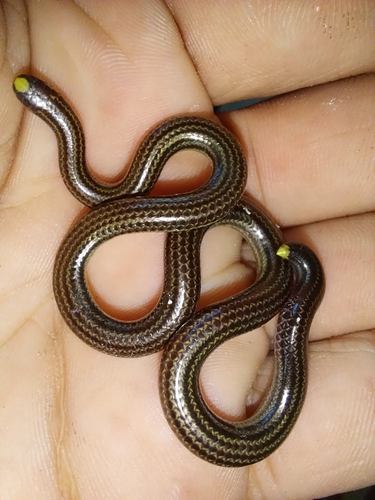
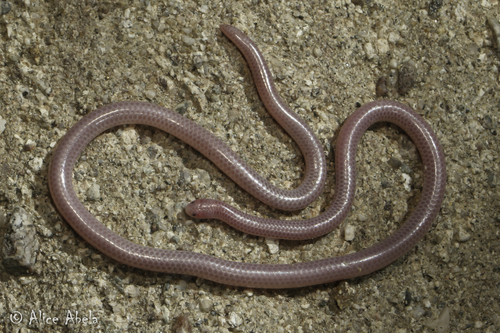
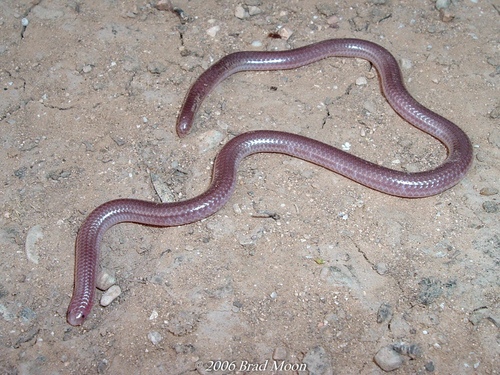
The Texas blind snake, Rena dulcis Baird & Girard, 1853, strongly resembles a shiny earthworm. It has a pinkish-brown, or puce, coloration with a deep sheen covering its scales, and its body does not appear segmented. Its eyes are only two small dark spots located underneath the scales on its head. This species has no teeth in its upper jaw, and its lower jaw is extremely short, measuring less than half the total length of the skull. When the snake consumes prey, it quickly flexes the front of its short lower jaw in a raking movement to fling prey into its esophagus; this feeding technique is unique to the family Leptotyphlopidae. Fully grown adults reach a total length, including the tail, of approximately 27 centimeters (11 inches). On the top of the head, between the ocular scales, R. dulcis has three scales, while the related species R. humilis has only one scale. R. dulcis occurs across the southwestern United States and northern Mexico. Within the United States, its range covers southwestern Kansas, western Oklahoma including the Oklahoma panhandle, central and southern Texas, and extends west through southern New Mexico. In northern Mexico, it has been recorded in Chihuahua, Coahuila, Tamaulipas, Nuevo León, San Luis Potosí, Veracruz, Querétaro, Hidalgo, and Puebla. The type locality recorded by Baird and Girard is "Between San Pedro and Camanche [sic] Springs, Tex.", which refers to Comanche Springs, Texas. This snake can be found in a wide range of habitat types, including desert, grassland, shrubland, savanna, and forest. R. dulcis reproduces via oviparity, meaning it lays eggs.