About Remiz consobrinus (Swinhoe, 1870)
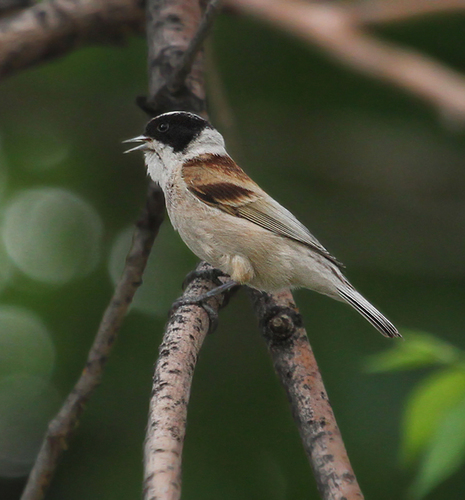
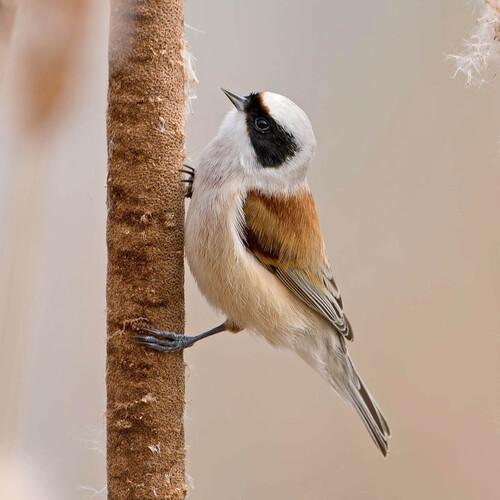
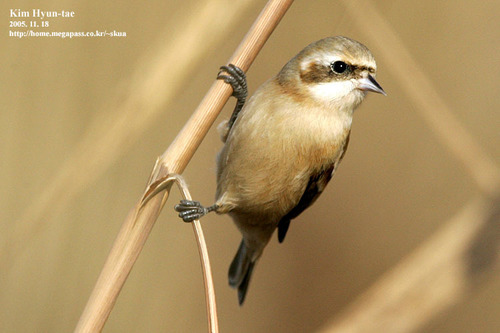
Adults of Remiz consobrinus, the Chinese penduline tit, measure 11 cm in total length. They are small, pale reedbed birds with fine-pointed bills, and are often found in flocks of 10 to 20 individuals. Males have greyish crowns and napes, a black mask starting at the forehead that is edged with white, and chestnut-colored mantle, half-collar, and wing-coverts that contrast with dark wings and a black tail when in flight. Their whitish underparts are marked with buff. Females have brown masks, and browner upperparts that lack chestnut coloring. This species occurs especially in reedbeds and marshes of Manchuria, and winters sparsely across eastern Asia, particularly along the Yangtze river valley; it winters across southern China. It occupies agricultural pastures and wetlands with marshes or brackish ponds during both breeding and non-breeding seasons. Its voice consists of very thin, drawn-out notes 'tseeoo' and 'sseeoo'. Chinese penduline tits are insectivorous, feeding on insects, insect larvae, caterpillars, and spiders; they will also eat small seeds occasionally, especially during winter. They are acrobatic climbers, and can remain suspended by one leg while collecting food with the other. For reproduction, the male selects a tree between 3 and 15 meters in height to support the nest. The nest of this species is an elaborate architectural structure shaped like a pear-shaped purse, extended by a tubular appendix, with a lateral entrance. After arranging the nest’s interior, the female typically lays between 5 and 10 eggs, which she incubates alone over 12 to 15 days. Once the young have fledged, the nest becomes deformed and partly falls apart. Fledged young return to this nest to roost for 15 to 20 days before leaving the area permanently.