About Reinhardtius hippoglossoides (Walbaum, 1792)
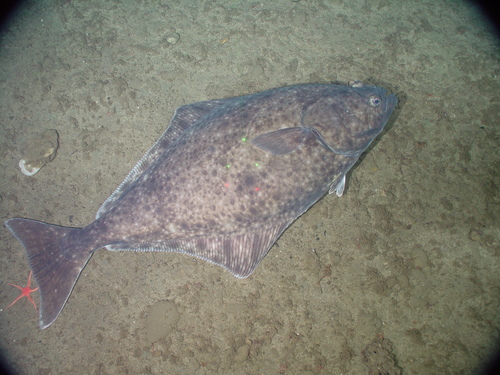
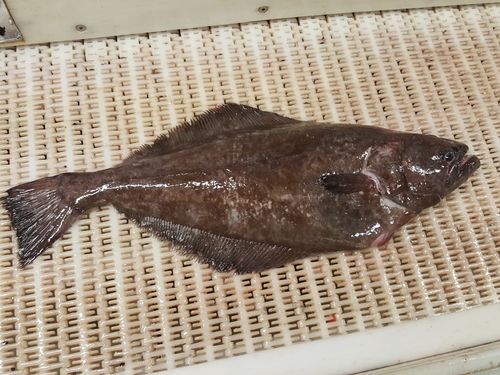
This section covers the morphological description, distribution, and habitat of Reinhardtius hippoglossoides, commonly called Greenland halibut. When viewed straight on, its left eye sits on the dorsal ridge of the forehead, giving the fish a cyclops-like appearance. Unlike other flatfish where the eye has fully migrated to one side, this central placement of the left eye likely gives Greenland halibut a much wider range of peripheral vision. The body of the fish is elongated and compressed dorsoventrally, with equally developed muscles on both sides. Both sides of the body are pigmented, though the left blind side is slightly lighter in color than the right side. This species reaches a maximum length of around 120 cm (3.9 ft) and maximum weight of around 45 kg (99 lb). Typical adult individuals measure 80–100 cm (2.6–3.3 ft) in length and weigh 11–25 kg (24–55 lb). Greenland halibut is a cold-water species that occurs at depths ranging from near the surface down to 2,200 m (7,200 ft), though most individuals live between 500 and 1,000 m (1,600 and 3,300 ft). It is most commonly found in waters with temperatures between 1 and 4 °C (34–39 °F), but has also been recorded at subzero temperatures as low as −2.1 °C (28.2 °F). It has a circumpolar distribution across the Northern Hemisphere, and is present in both the North Atlantic and North Pacific Oceans. In the North Pacific, its range extends from the Sea of Japan near Honshu north to the Chukchi Sea, east through the Aleutian Islands, and south to northern Baja California, Mexico. In the North Atlantic, it occurs from the British Isles to northern Norway, the Faroe Islands, Iceland, and eastern Greenland in the eastern part of the basin, and from Newfoundland to northwestern Greenland in the western part of the basin.