About Regulus satrapa Lichtenstein, 1823
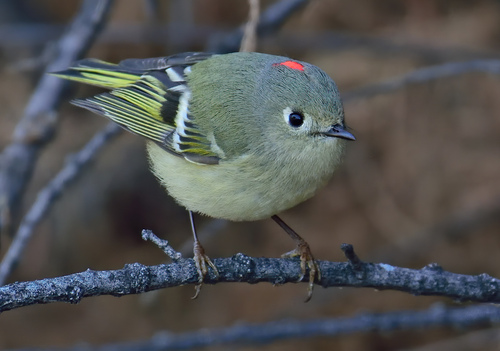
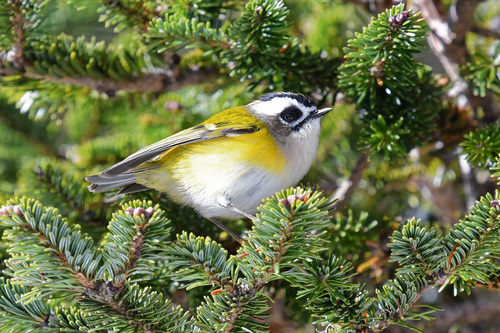
This species is the golden-crowned kinglet, with the scientific name Regulus satrapa Lichtenstein, 1823. Adult golden-crowned kinglets have olive-gray upperparts, white underparts, thin bills, and short tails. They have white wing bars, a black stripe running through their eyes, and a yellow crown bordered by black. Adult males have an additional orange patch in the center of the yellow crown. Juveniles look similar to adults, but have a browner back and lack the yellow crown. Golden-crowned kinglets are one of the smallest passerines found in North America. They measure 8 to 11 cm (3.1 to 4.3 inches) in length, making them likely the shortest of any American passerine species. Their weight averages 6.1 g (0.22 oz) for females and 6.3 g (0.22 oz) for males, and ranges from 4.5 to 7.8 g (0.16 to 0.28 oz) overall, which is similar to the weight of the American bushtit and black-tailed gnatcatcher. This species has a wingspan of 14 to 18 cm (5.5 to 7.1 in). The golden-crowned kinglet is a widespread migratory bird that occurs across North America. Its breeding habitat consists of coniferous forests across Canada, the northeastern and western United States, Mexico, and Central America. During the non-breeding season, this species migrates to the United States. Some individuals are permanent residents in coastal regions and in the southern parts of the species' range. Northern populations of golden-crowned kinglet stay further north during winter than ruby-crowned kinglets. The golden-crowned kinglet is an insectivorous bird that forages in trees and shrubs. It feeds primarily on insects (especially caterpillars), insect eggs, and spiders. It produces a series of high-pitched calls all on a single note, and generally does not avoid approaching humans. Its nest is a well-concealed hanging cup shape, suspended from a conifer branch. Golden-crowned kinglets may huddle tightly together when they overwinter.