About Regulus regulus (Linnaeus, 1758)
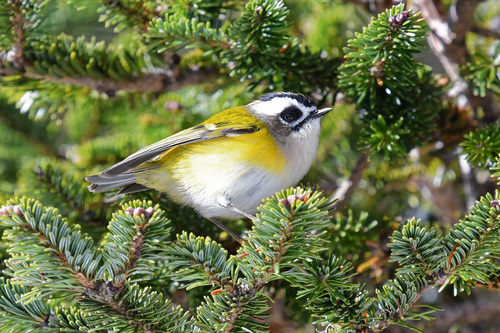
The goldcrest, Regulus regulus, is the smallest bird found in Europe. It measures 8.5–9.5 cm (3.3–3.7 in) in length, has a wingspan of 13.5–15.5 cm (5.3–6.1 in), and weighs 4.5–7.0 g (0.16–0.25 oz). In appearance it resembles a warbler, with olive-green upperparts, buff-white underparts, two white wing bars, and a plain face with prominent black irises. The crown has black sides and a narrow black front, topped with a bright crest: the crest is yellow with an orange center in males, and entirely yellow in females. When erected for display, the male’s distinctive orange stripe becomes much more visible. The goldcrest has a small, thin black bill and dark flesh-brown legs. Apart from crest color, males and females look similar, although females with fresh plumage may have very slightly paler upperparts and greyer underparts than adult males. Juveniles resemble adults but have duller upperparts and lack the colored crown. While juvenile tail and flight feathers may be kept through the first winter, by that time young birds are almost impossible to tell apart from adults in the field. Goldcrests have a distinctive flight pattern consisting of whirring wing beats followed by occasional sudden direction changes. Shorter feeding flights are a mix of dashing and fluttering, with frequent hovering. They move restlessly through foliage, regularly creeping along branches and up and down tree trunks.
The goldcrest can usually be easily distinguished from other small birds within its range, but poor views can lead to confusion with the common firecrest or yellow-browed warbler. Adult common firecrests have a distinct face pattern with a bright white supercilium (eyebrow) and black eye stripe, and even juvenile common firecrests usually show enough of this pattern to separate them from the plain-faced goldcrest. Yellow-browed warblers have a yellowish supercilium and pale crown stripe, giving them a different head pattern from the goldcrest. The ruby-crowned kinglet, an American Regulus species that is a potential vagrant in Europe, may be harder to distinguish. It shares the goldcrest’s plain face, but the male ruby-crowned kinglet has a red crest with no yellow and no black border. Female and juvenile ruby-crowned kinglets lack the ruby-red crown patch, but compared to the similarly crestless juvenile goldcrest, American ruby-crowned kinglets are larger, have an obvious whitish eyering, and yellowish wing bars.
Goldcrests breed in mature lowland and mountain coniferous woodlands, mostly up to 3,000 m (9,800 ft), and occasionally as high as 4,800 m (15,700 ft). They use spruce, larch, Scots pine, silver fir, and mountain pine, and will also use introduced conifers such as Douglas fir in human-made landscapes. Breeding densities as high as 591 pairs per square kilometer (1,530 pairs per square mile) have been recorded in Norway spruce in Ireland, and goldcrests made up over 60% of all birds found in Welsh Douglas fir and Norway spruce plantations. Broad-leaved woods are only used if spruce or firs are also present, and parks and cemeteries are only used if they provide suitable conifers that are not available elsewhere locally. The height and type of undergrowth does not affect site use. Unlike more specialized birds such as the Eurasian nuthatch and Eurasian treecreeper, which both forage on tree trunks, kinglets do not require large woodlands, and their population density does not depend on forest size. After breeding season ends, goldcrests readily move into deciduous trees and shrubs, heathland, and other more open habitats. The Tenerife subspecies lives in mountain regions previously covered by laurisilva that are now dominated by tree heaths. It is only common in this tree heath habitat, becoming rare in pine forest, where it occurs only when tree heath is also present.
The goldcrest has an extremely large range across Eurasia, breeding from Macaronesia to Japan. It is common in middle and northern temperate and boreal latitudes of Europe, between the 13–24 °C (55–75 °F) July isotherms, so it predominantly lives in cooler climates than the firecrest. Further east, it occurs discontinuously through southern Siberia to Sakhalin and Japan, in the Tian Shan mountains, northern Iran, and from the Himalayas east to central China. This species has bred in Iceland since around 1999, and was widespread by 2004, although population numbers are impacted by hard winters. Breeding occurs intermittently in the Faroes. The goldcrest has been recorded as a vagrant in Jordan and Morocco.
This species is partially migratory, with the northernmost populations leaving their breeding areas for winter. Goldcrests winter in Europe and Asia south of the breeding range. Birds in northern Fennoscandia and Russia leave their territories between late August and early November, with most departing in late September to mid-October when the first cold weather arrives. Adverse conditions can cause disorientation, leading large numbers to gather on ships during overcast or wet nights. Large recorded influxes include 15,000 birds on the Isle of May in October 1982, and nearly 21,000 birds passing through a single site in Latvia during September and October 1983. Spring migration is complete by late March on Mediterranean islands, but continues to late April or early May in northern Europe. Spring passage is much lighter than autumn passage, which suggests high mortality during migration. A study in the Baltic region found that northern goldcrests are more likely to migrate, and they increase their body mass before departure; non-migratory southern goldcrests do not build up extra fat reserves. The travel speed of migrating goldcrests is higher for birds that leave later in autumn, and is also greater for the northernmost populations. Migration is faster along routes that cross the Baltic Sea than along coastal routes, and birds with the largest fat reserves travel at the highest speeds. The ability to build up fat stores is negatively impacted by poor health in this very small bird. In Hungary, migrating goldcrests stopping to rest are mostly found in scrub including blackthorn, hawthorn, and pear, which provides some protection from sparrowhawks. Females migrate slightly earlier than males, and overall more males are recorded, giving an average sex ratio of 1.6:1. Migrating goldcrests can fly 250–800 km (160–500 mi) in a single day, although they fly at lower altitudes when facing strong headwinds. This is a tame and inquisitive species, and tired migrants will land near or on humans, sometimes even searching for food on people’s clothing.
The North Atlantic oscillation is an atmospheric phenomenon that impacts weather in Western Europe. When atmospheric pressure variations in the North Atlantic are large, European springs are warmer. This causes the northward migration of bird species that winter mainly in western or southern Europe, including the goldcrest, to happen earlier. Broad climatic change has led to more frequent positive North Atlantic oscillation events since the 1980s, which has resulted in earlier spring migration for these short-distance migrants. Warmer spring weather triggers plant growth, which prepares habitat for returning migrants. This effect is strongest in western and central Europe.