About Regulus madeirensis Harcourt, 1851
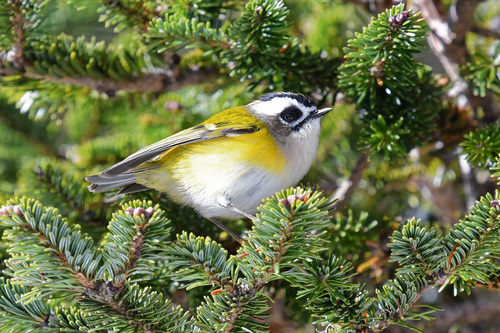
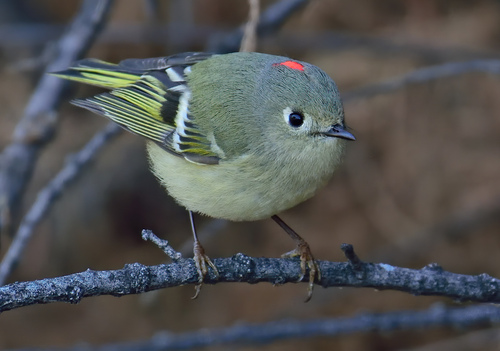
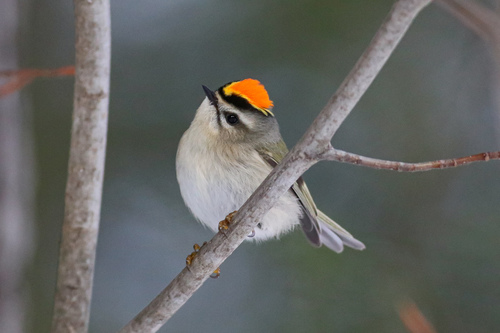
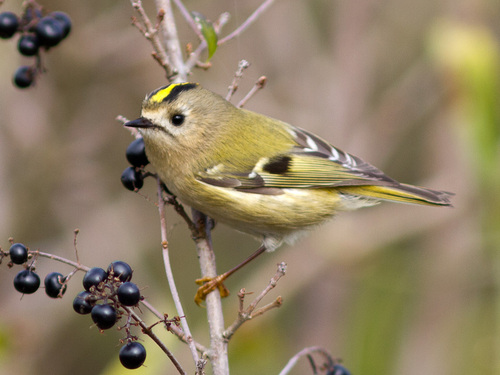
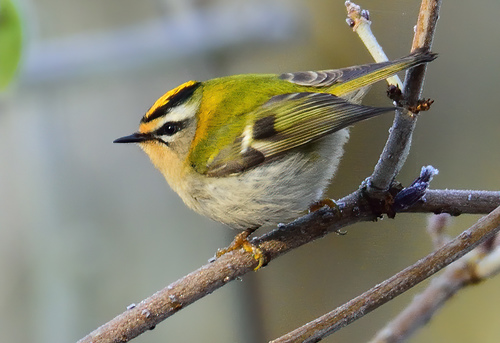
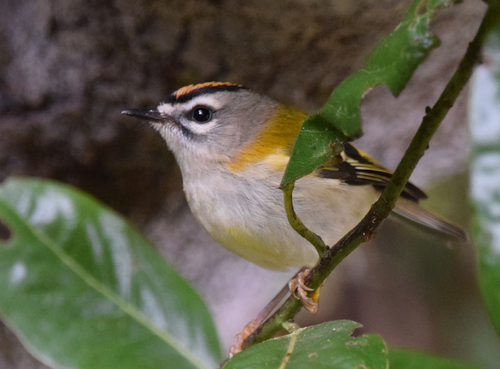
The Madeira firecrest (Regulus madeirensis Harcourt, 1851) is a small, plump kinglet. It measures 9–10 cm (3.5–3.9 in) in length and weighs approximately 5 g (0.18 oz). It has bright olive-green upperparts with a bronze-coloured patch on each shoulder, and whitish underparts marked with a brownish-grey wash on the breast and flanks. It has two white wingbars, a tiny black bill, and brownish-black legs. Its striking head pattern includes a black eye stripe, a white supercilium, and a crest that is yellow in females and mainly orange in males. Juveniles have duller upperparts with a grey tinge, and lack the adult crown pattern, eye stripes, and supercilium. By their first winter, only their flight and tail feathers remain unmoulted, and young birds are almost impossible to tell apart from adults when observed in the field. This kinglet typically hops while holding its body horizontally, and its flight is weak and whirring, with occasional sudden jinking turns. When compared to the common firecrest, the Madeira firecrest has a longer bill and legs, a shorter white supercilium, more black markings on its wings, and a deeper golden-bronze shoulder patch; the male Madeira firecrest also has a duller orange crest. Juvenile Madeira firecrests have plainer heads, and do not have the dull supercilium seen in young common firecrests. Both the Madeira firecrest and the common firecrest produce high-pitched vocalisations, but the Madeira firecrest's song is divided into three distinct parts. In contrast, the common firecrest's song accelerates gradually and covers a much smaller frequency range. Both species have high-pitched fine calls described as zuu zu-zi-zi, though the Madeira firecrest also has a distinctive shrill wheeze and a whistled peep call. The Madeira firecrest is endemic to the main island of Madeira. It is found mainly at elevations between 600 and 1,550m (1,950–4,900ft), and occurs in all types of forest and scrub, though it prefers tree heath habitats. It may descend to lower elevations after the breeding season. While it is strongly adapted to native endemic tree heaths, it also breeds in broom, Vaccinium, relict laurel forest, oak-dominated deciduous forest, and stands of the introduced Japanese cedar, Cryptomeria japonica. It is not found in introduced alien eucalyptus and acacia plantations, which have replaced large areas of the endemic Madeiran laurel forest.