About Regulus ignicapilla (Temminck, 1820)
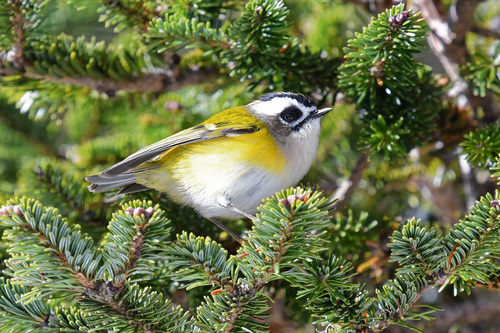
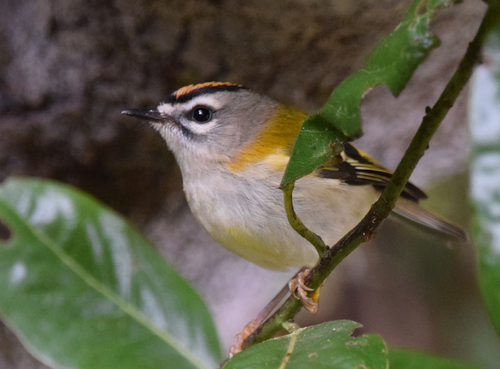
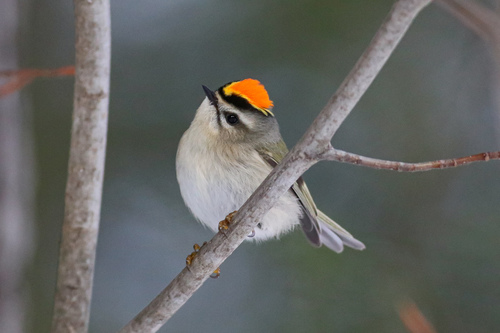
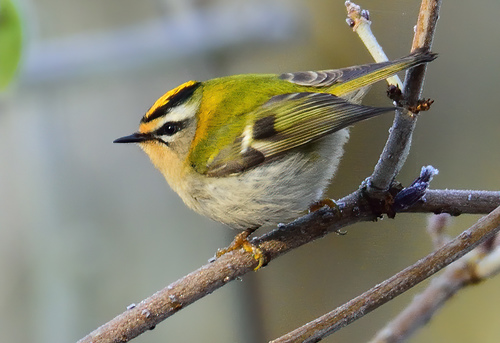
The common firecrest (scientific name: Regulus ignicapilla (Temminck, 1820)) is a small plump bird. It measures 9 cm (3.5 in) in length, has a wingspan of 13–16 cm (5.1–6.3 in), and weighs 4–7 grams (0.14–0.25 oz). It has bright olive-green upperparts with a bronze-coloured patch on each shoulder, and whitish underparts with brownish-grey tint on the breast and flanks. It has two white wingbars, a tiny black pointed bill, and brownish-black legs. Its head pattern is striking: it has a black eye stripe, long white supercilium, and a crest that is bright yellow in females and mainly orange in males. The sexes are very similar aside from crest colour; females are a little duller in plumage and on average slightly smaller. Juveniles have a grey tinge on their duller upperparts, and lack the coloured crown. Their other head markings are present but duller than adults. By their first winter, only flight and tail feathers remain unmoulted, and young birds are virtually indistinguishable from adults in the field. This kinglet usually hops with its body held horizontally, and its flight is weak and whirring, with occasional quick evasive turns.
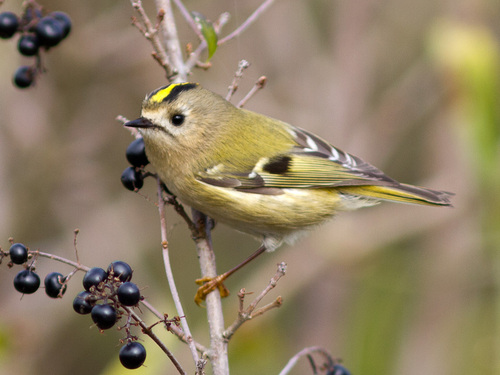
Adult firecrests are unlikely to be confused with other species. Pallas's warbler has a similar head and wing pattern, but its crown stripe is pale lemon (not bright yellow or orange) and its supercilium is pale yellow (not bright white). Juvenile common firecrests might be confused with goldcrests, but common firecrests usually have enough distinct face pattern to tell them apart, as goldcrests have very plain faces at all ages. The firecrest can also be separated from Pallas's warbler by Pallas's warbler's pale crown stripe and yellow rump. Juvenile firecrests are more likely to be confused with yellow-browed warblers, which have a similar head pattern; the Asiatic yellow-browed warbler has pale fringes on the feathers of the closed wing, a whitish belly and darker brown legs, and also lacks the pale half circle below the young firecrest's eye.
Regarding distribution and habitat: The common firecrest breeds in lowland broadleaf forest, preferring cork oak and alder when available, otherwise beech and holly. It also uses mixed broadleaf and conifer woodland, and stands of spruce, European silver fir, cedar and pines, often with undergrowth of juniper, ivy and wild rose. In drier Mediterranean habitats, it is found in conifers, evergreen oak, and mixed woodlands up to 2,800 m (9,200 ft). Unlike more specialised birds such as Eurasian nuthatch and common treecreeper, which forage on trunks, crests do not need large woodlands, and their population density is independent of forest size. In winter it is less reliant on conifers than the goldcrest, moving from forest to fringes and scrub. It occurs singly or in pairs, spends much of its time in the tree canopy, and frequently ventures into bushes and other lower vegetation. This species can thrive in fairly urban areas as long as suitable habitat is available in parks or large gardens; population densities in gardens can be comparable with the maximum levels found in natural habitats.
The nominate subspecies breeds in Europe from southern England, France, Spain and Portugal east to Belarus, northwestern Ukraine, and Greece, and north to the Baltic and southern Latvia. There are isolated populations east of the main range in Abkhazia, the Crimea and Turkey. Its range lies between the 16 and 24 °C (61 and 75 °F) July isotherms. Southern birds are largely resident, while northern and eastern populations are migratory, wintering mainly in Mediterranean areas and the far west of Europe from Portugal north to Britain. R. i. balearicus is resident in the Balearic Islands and the northern parts of Morocco, Algeria and Tunisia. This species has been recorded as a vagrant from Norway, Finland, Estonia, Cyprus, Egypt and Lebanon. In July 2020, it was reported that the common firecrest was now nesting in at least two locations in southern Finland.