About Reduvius personatus (Linnaeus, 1758)
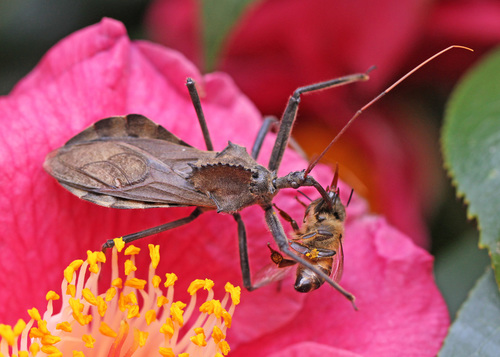
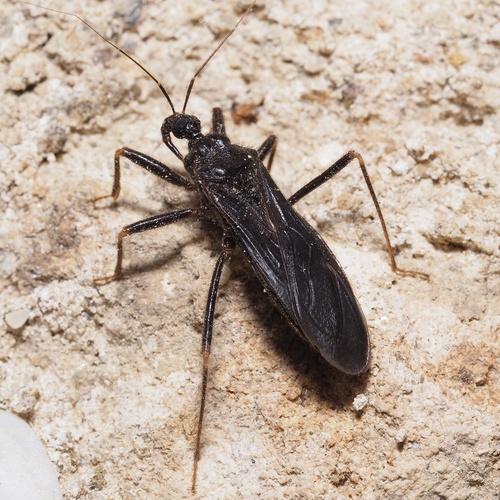
Identification: Adult masked hunters (Reduvius personatus) are uniformly dark brown to black, and measure between 17 and 22 mm in body length. They have an elongated head that bears a short, three-segmented beak, as well as long, slender antennae. Their abdomen is wide, and its middle portion extends beyond the wings, exposing the lateral margins of the abdominal segments. Nymphs of this species share a similar body shape to adults and are naturally dark in color, but they often look gray or light-colored because a layer of debris covering them acts as camouflage. Nymphs produce a sticky substance that coats their entire body, including their antennae and all six legs. This sticky coating causes dust, lint, and other small particles to stick to their body surface. Distribution: The masked hunter has a Holarctic distribution. It is native to Europe and western Asia, and has been introduced to Australia, India, Africa, and North America. It was probably accidentally introduced to North America between the late 1800s and early 1900s. It was first recorded in Canada in 1905, and in the United States in 1917, and it is now common in the Central and Eastern United States.