About Redunca arundinum (Boddaert, 1785)
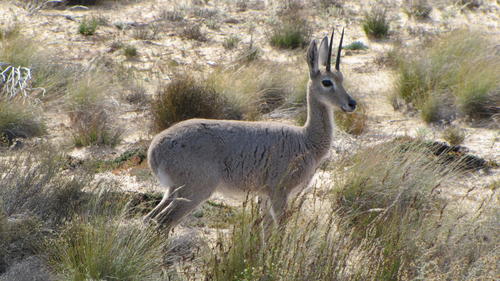
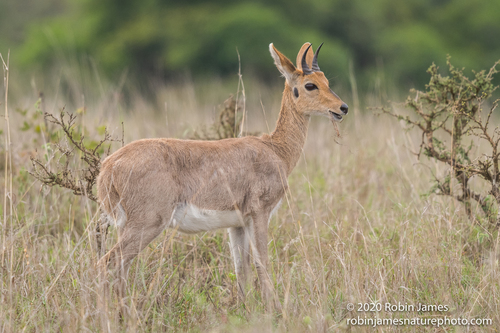
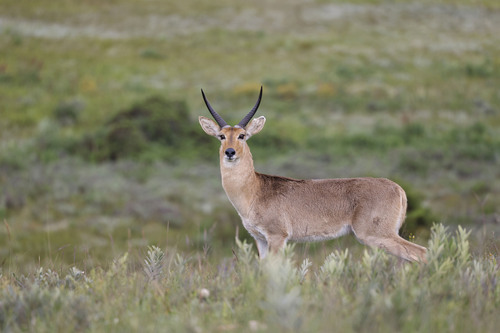
The southern reedbuck (scientific name Redunca arundinum (Boddaert, 1785)) is larger than the other two species in the Redunca genus: R. redunca (Bohor reedbuck) and R. fulvorufula (mountain reedbuck). It stands 80–90 cm (31–35 in) at the shoulder, with an average shoulder height of 85 cm (33 in). Females weigh 48 kg (106 lb), while males weigh 68 kg (150 lb). Females do not have horns. Males have forward-curving horns that are around 35–45 cm (14–18 in) long, with a distinct band of pale, rubbery tissue at the base of each horn. The southern reedbuck has a silky, almost woolly coat that ranges in color from light to greyish-brown, and may be lighter on the neck and chest. Distinctive dark lines run down the front of each of its forelegs and lower hindlegs, and it has whitish rings around its eyes. There is a small, black, bare glandular patch at the base of each ear. White fur covers its underparts, and the areas near its lips and chin. The underside of its short, bushy tail is white. Its typical lifespan is 10 years. Southern reedbucks have a wide distribution that stretches from Gabon and Tanzania to South Africa, with their range extending north into Miombo woodlands. They are native to Angola, Botswana, the Republic of the Congo, the Democratic Republic of the Congo, Gabon, Malawi, Mozambique, Namibia, South Africa, Eswatini, Tanzania, Zambia, and Zimbabwe. Their presence in Lesotho is considered doubtful. They formerly occurred locally in the savannas of southern Republic of the Congo, but are thought to be extinct there now. They live in moist grasslands with tall grass, reeds, sufficient cover, and nearby water, including habitats like floodplains, pastures, woodlands, and valleys. They are common in seasonally flooded valleys near the Malagarasi River, and also live in the southern savannas of Tchibanga and Ndende in the Democratic Republic of the Congo. They can be found in protected areas and regions with low to moderate human settlement, and have large populations in Selous National Park (Tanzania), Kafue National Park (Zambia), Nyika National Park (Malawi), Gorongosa National Park (Mozambique), Okavango National Park (Botswana), Kruger National Park and Eastern Shores (South Africa). There are also significant populations on private land in Zimbabwe, South Africa, and Namibia. Southern reedbucks typically live alone or in pairs, but may occasionally form herds of around 20 individuals. They rest in grass or reed beds during the heat of the day, and feed at sunrise, sunset, and sometimes at night. Older adult reedbucks are permanently territorial, holding territories of around 35 to 60 hectares, and usually live with a single female while preventing access to rival males. Females and young males perform an 'appeasement dance' for older males. During this dance, young bucks run quickly and make long jumps, holding their tails curled up; scented air is released from a groin pocket with each bounce, creating a popping sound. Within his territory, a male is active throughout the day in summer, but becomes nocturnal in the wet season. Southern reedbuck regularly use fixed paths to travel between resting, grazing, and drinking sites. The average lifetime home range is estimated at 123 hectares for females and 74 hectares for males. The main predators of southern reedbuck are lions, leopards, cheetahs, spotted hyenas, Cape hunting dogs, and Nile crocodiles. Their coat coloration matches their grassland habitat, allowing them to camouflage effectively. If startled or attacked, they first stand still, then either hide or flee with an unusual rocking-horse movement, and typically pause to look back cautiously to confirm the danger has passed. They use vocalizations including a shrill whistle made through the nostrils and a clicking noise to alert other reedbucks to danger. Southern reedbuck can breed throughout most of the year, though most matings take place during the hot and wet season. Females reach sexual maturity at two years old, when they leave their parent's territory. Males reach sexual maturity at a slightly older age, and may stay with their family group until they are three years old. Each birth produces a single young, after a gestation period of seven to eight months. The newborn stays in the dense tall grass cover where it was born for the first two months of its life. The female does not remain with her young, instead visiting only once per day for 10 to 30 minutes to nurse it.