About Recurvirostra novaehollandiae Vieillot, 1816
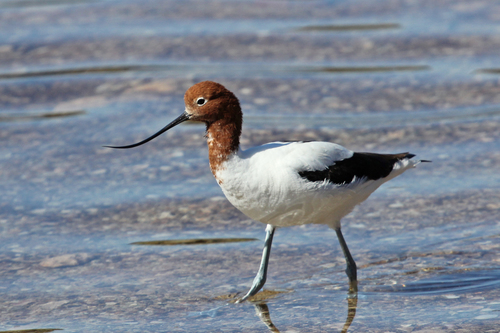
The red-necked avocet (Recurvirostra novaehollandiae Vieillot, 1816), like all avocet species, has a distinctive upcurved bill, which it uses to skim the surface of water to catch small invertebrates. Adult red-necked avocets have a rich chestnut brown head and neck — the feature that gives the species its common name — along with a narrow white eye ring and a red-brown iris. Their secondary coverts and primary feathers are black, and the rest of their plumage is white. The bill is black, and the legs are pale grey-blue. Males and females are similar in both coloration and size, and there is no seasonal variation in appearance. Juveniles resemble adults and are difficult to distinguish once post-juvenile moult begins; their heads are sometimes paler and browner than adults' heads. On average, adult red-necked avocets measure 43–45 cm (17–17.5 in) from head to tail, have a total wingspan of approximately 75 cm (29.5 in), with a wing length of 22.4–23 cm, tail length of 7.9–8.8 cm, bill length of 8.2–9.5 cm, and a body weight of around 310 g. The species' call has been described as yapping, and flocks in flight produce a sound similar to barking dogs. Like many Australian waterbirds, the red-necked avocet is highly nomadic, largely in response to highly variable rainfall across the continent, and moves around Australia to find suitable habitat. It has a very wide range across Australia, but is comparatively rare on the northern and north-eastern coasts. It prefers salt or brackish water, and is generally found in shallow freshwater or saltwater wetlands, or on estuarine mudflats. It is rare in Tasmania, and is an occasional vagrant to New Zealand. During the breeding season, red-necked avocets are mainly found in loose colonies, and disperse into small flocks for the rest of the year. They are social in all activities and during all seasons, and readily associate with stilts. Pre-mating courtship includes bill crossing and bowing dances; the female indicates readiness to mate by crouching low with spread wings, and this interaction usually takes place in shallow water. Each breeding pair defends its nesting territory through a range of displays and postures, and will swoop repeatedly at intruders. The red-necked avocet's vocalizations are similar to those of other avocets. Common calls include a clear, fluty 'tuut' or 'kluut' that generally acts as a contact call, while shorter, sharper yelping notes are used as warning calls. When conditions are suitable, the species can be fairly sedentary, but will quickly move to coastal areas during dry weather. Red-necked avocets nest in loose, rarely large, colonies, mainly between August and November. Breeding timing is highly variable, and depends on rainfall and water availability. Breeding most often occurs in the south-western interior on swamps and mudflats after rain, though small breeding colonies have been recorded on Port Phillip Bay near Melbourne, Victoria. The nest is a shallow scrape lined with samphire or similar aquatic vegetation. Clutch size is 3–4 eggs, most often 4; the eggs are pyriform, pale brown with some speckled sepia markings, and measure 36 by 50 mm. The eggs are arranged in a circle, with their narrow acute ends pointing toward the center.