About Ravenala madagascariensis Sonn.
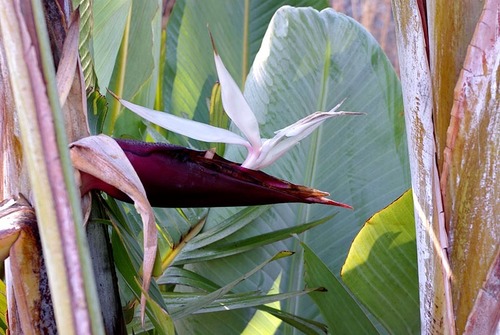
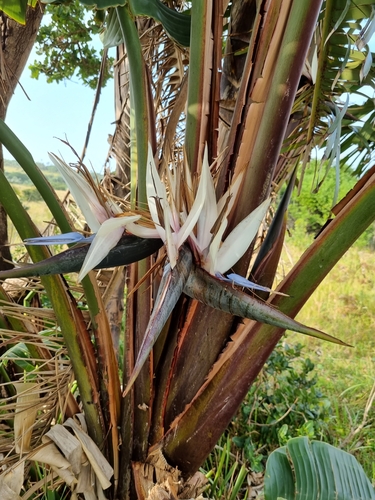
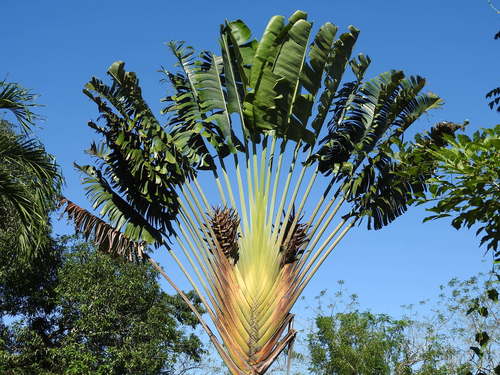
Ravenala madagascariensis Sonn. produces enormous paddle-shaped leaves that grow on long petioles. These leaves are arranged in a distinctive fan shape aligned in a single plane, called a distichous arrangement. Mature specimens form a foliar fan made of 30 to 45 leaves, and each leaf can reach up to 36 feet (11 metres) in length. As the plant ages, it gradually sheds its lowest, oldest leaves, revealing a sturdy grey trunk. There are four recognized forms, varieties, or subspecies of this plant; the largest is known as "Bemavo", which grows in the hills of eastern Madagascar. Bemavo can reach 100 feet (30 metres) in height, with a trunk 2 feet (60 cm) thick. Its large white flowers are structurally similar to the flowers of its close relatives Strelitzia reginae and Strelitzia nicolai, common bird-of-paradise flowers. However, Ravenala madagascariensis flowers are generally considered less attractive, and they have a green bract. After pollination, these flowers develop into brilliant blue seeds. The chromosome number of this species is 2n = 22. Ravenala madagascariensis is widespread across Madagascar, where it grows in multiple habitat types including humid lowland forests, montane forests, grassland, and rocky areas. Its range extends from sea level up to 1,500 meters in elevation. Ruffed lemurs are a documented pollinator of Ravenala madagascariensis. Based on the size and structure of the plant's inflorescences, as well as the lemur's feeding selectivity, feeding method, and long muzzle, this plant-pollinator relationship is thought to be the product of coevolution. When cultivated, this plant needs a sunny location; young plants do not need full sun until they grow larger. It responds well to fertilizer, particularly nitrogen-rich fertilizer applied during the growing season, which supports better growth and foliage development. Cultivated plants reach an average height of 7 m (23 ft), and require moderate amounts of water.