About Rattus norvegicus (Berkenhout, 1769)
Scientific name: Rattus norvegicus (Berkenhout, 1769)
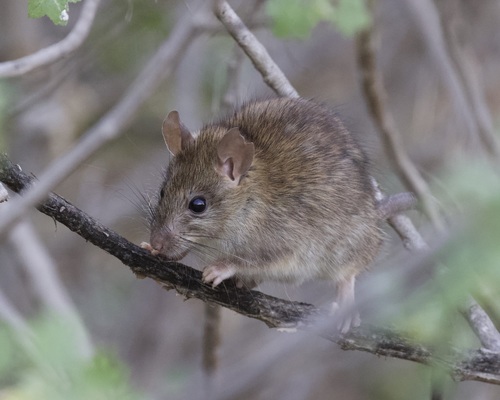
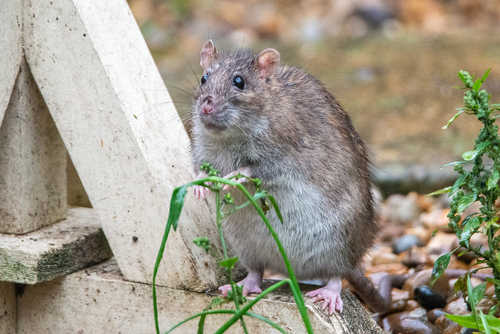
Description The fur of the brown rat is typically brown or dark grey, with lighter grey or brown underparts. This is a fairly large murid rodent; it can weigh twice as much as a black rat (R. rattus), and many times more than a house mouse (Mus musculus). Head and body length ranges from 15 to 28 cm (5.9 to 11.0 in), while tail length ranges from 10.5 to 24 cm (4.1 to 9.4 in), making the tail shorter than the combined head and body length. Adult weight generally ranges from 140 to 500 g (4.9 to 17.6 oz). Large individuals can reach 800 g (28 oz), though this size is only expected among domestic specimens. Claims of brown rats growing to the size of cats are either exaggerations or misidentifications of other larger rodents. Most breeding wild brown rats weigh less than 300 g (11 oz). The heaviest confirmed live brown rat on record weighs 822 g (29 oz), and the species can reach a maximum total length of 482.5 mm (19 in).
Brown rats have acute hearing, are sensitive to ultrasound, and have a very highly developed sense of smell. Their average heart rate is 300 to 400 beats per minute, with a respiratory rate of around 100 breaths per minute. Vision is poor in pigmented brown rats, at roughly 20/600. Non-pigmented rats with no melanin in their eyes have even worse vision of around 20/1200, plus severe light scattering within the eye. Brown rats are dichromats, meaning they perceive color in a similar way to humans with red-green color blindness, and their color saturation is often quite faint. Their blue perception includes UV receptors, however, which lets them see ultraviolet light that humans and many other species cannot detect.
Distribution and habitat The brown rat likely originated from the plains of northern China and Mongolia, and spread to other regions of the world during the Middle Ages. The question of when the species became commensal with humans is still unresolved, but brown rats have spread and established populations along routes of human migration, and now live almost anywhere humans reside. Evidence suggests the brown rat may have been present in Europe as early as 1553, based on an illustration and description by Swiss naturalist Conrad Gesner in his work Historiae animalium, published 1551–1558. While Gesner's description could also fit the black rat, his note that a large percentage of the specimens were albino, a trait not uncommon in wild brown rat populations, lends credibility to the conclusion that this was Rattus norvegicus. Reliable 18th-century records document the brown rat's presence in Ireland in 1722, England in 1730, France in 1735, Germany in 1750, and Spain in 1800, and the species became widespread across Europe during the Industrial Revolution. It did not arrive in North America until around 1750–1755.
As it spread outward from Asia, the brown rat generally displaced the black rat in human-occupied areas. In addition to being larger and more aggressive than black rats, the shift from wooden structures and thatched roofs to bricked and tiled buildings favored burrowing brown rats over tree-dwelling black rats. Brown rats also eat a wider range of foods and are more resistant to extreme weather conditions. Without human presence, brown rats prefer damp environments such as river banks. Today, the great majority of brown rats are associated with human-made environments, including sewage systems. It is often claimed that cities have as many rats as people, but population numbers vary between areas based on factors like climate and local living conditions. Urban brown rats usually do not travel far, often staying within 20 m (66 ft) of their nest if a reliable concentrated food source is available, but will range more widely when food is less available. It is hard to measure the full extent of their home range because they do not use an entire open area, instead relying on regular runways to travel between locations. There is significant debate over the size of the rat population in New York City, with estimates ranging from just 250,000 up to almost 100 million. Experts note New York City is particularly attractive to brown rats due to its aging infrastructure and high poverty rates. In 2023, the city appointed Kathleen Corradi as the first Rat Czar, a new role created to address the city's rat population. The position focuses on implementing policies and measures to curb the population, such as updated garbage regulation and additional rat trapping. In addition to sewers, brown rats thrive in alleyways and residential buildings, as these areas usually provide a large, steady food source.
Some figures indicate the brown rat population has been rising in the United Kingdom, with estimates placing the total UK population at 81 million, which equals roughly 1.3 rats per human resident. High UK rat populations are often linked to the country's mild climate, which gives rats higher survival rates during the winter. It is estimated that brown rat populations will increase further as global temperatures rise and glaciers retreat. In tropical and desert regions, brown rat occurrence is generally limited to human-modified habitats. Confirmed rat-free areas of the world include the entire continent of Antarctica, the Arctic, some isolated islands, the Canadian province of Alberta, and certain conservation areas in New Zealand. Most of Australia, apart from eastern and south-eastern coastal regions, has no reported substantial populations of brown rats.
Antarctica is uninhabitable for rats. The Arctic has extremely cold winters that rats cannot survive outdoors, and has very low human population density, making it hard for rats to travel between human habitations, though they have arrived in many coastal Arctic areas by ship. When an occasional infestation is found and eliminated, rats cannot re-infest the area from nearby neighboring populations. Isolated islands can also maintain rat-free populations due to low human population density and geographic distance from areas with established rat populations.
Reproduction and life cycle Brown rats can breed year-round when conditions are suitable, and a single female can produce up to five litters per year. The gestation period is just 21 days, and litters can have up to 14 pups, though seven pups per litter is typical. Pups weigh an average of 6 g (0.2 oz) at birth. They reach sexual maturity at roughly five weeks old. Under ideal conditions for the species, the female population can increase by a factor of three and a half in 8 weeks (five weeks to reach sexual maturity plus three weeks of gestation), which corresponds to a total population growth by a factor of 10 in just 15 weeks. As a result, a starting population of 2 brown rats can grow to 15,000 in one year. The maximum lifespan of a brown rat is three years, though most individuals live barely one year. An annual mortality rate of 95% is estimated, with predation and interspecific conflict as the main causes of death.
While lactating, female brown rats follow a 24-hour rhythm of maternal behavior, and typically spend more time caring for smaller litters than they do for larger ones. Brown rats live in large, hierarchical social groups, in burrows or subsurface locations such as sewers and cellars. When food is scarce, the lowest-ranked rats in the social hierarchy are the first to die. If a large portion of a rat population is exterminated, the remaining rats will increase their reproductive rate, and quickly restore the population to its original size. Females can become pregnant immediately after giving birth, and can nurse one litter while carrying another. They are able to produce and raise two healthy litters of normal size and weight without significantly increasing their own food intake. However, when food is restricted, females can extend pregnancy by more than two weeks, and still give birth to litters with normal numbers of healthy normal-weight pups.
Uses in science Selective breeding of white-marked rats, originally rescued from death in the now-outlawed sport of rat baiting, produced the pink-eyed white laboratory rat. Like laboratory mice, these brown rat strains are frequently used as subjects in medical, psychological, and other biological experiments, and are an important model organism. This is because they grow quickly to sexual maturity, and are easy to keep and breed in captivity. When modern biologists refer to "rats", they almost always mean Rattus norvegicus.