About Rapana venosa (Valenciennes, 1846)
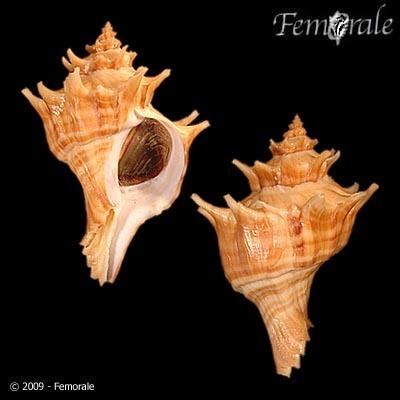
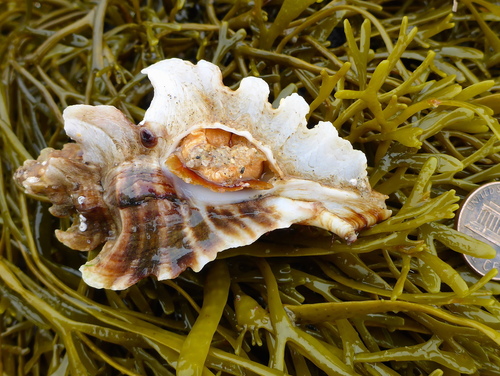
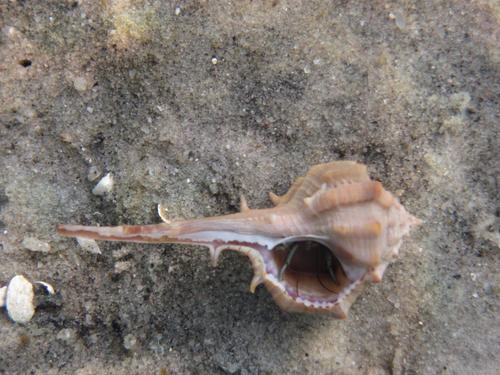
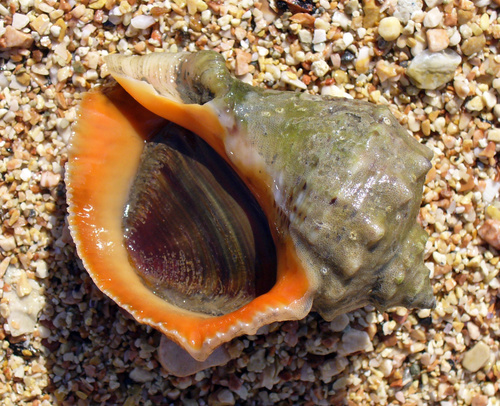
Rapana venosa (Valenciennes, 1846) has a globose, heavy shell with a very short spire, large body whorl, strong columella, and deep umbilicus. Its aperture is large and roughly ovate. Externally, the shell is ornamented with axial ribs and smooth spiral ribs that end in blunt knobs at the shoulder and body whorl; internally, small elongated teeth run along the margin of the outer lip. External shell color ranges from gray to reddish-brown, with dark brown dashes on the spiral ribs. Some specimens have distinctive black or dark blue vein-like color patterns across the inner shell, which usually originate from each tooth on the outer lip. A key diagnostic feature of this species is the deep orange color of the aperture and columella. The shell can reach a maximum height of 180 mm, or about 7 inches. This species is native to the marine and estuarine waters of the western Pacific, found in the Sea of Japan, Yellow Sea, East China Sea, and Bohai Sea. It is listed in Russia's Red Book as threatened with extinction. While its original range was limited to the Far East, it has been found in the Black Sea since 1947, and its shell became a popular souvenir in Crimea. More recently, it has been recorded as an exotic species in Chesapeake Bay, on the eastern coast of the United States. Authors generally attribute the spread of this species outside its natural range to transport of its planktonic larval stage in ship ballast water, or transport of its egg masses with marine farming products. Rapa whelks were first recorded in the Black Sea in the 1940s. Within a decade, the mollusk had spread along the Caucasian and Crimean coasts and moved into the Sea of Azov. Between 1959 and 1972, its range extended into the northwest Black Sea, reaching the coastlines of Romania, Bulgaria, and Turkey. It has since become established in the Adriatic and Aegean seas, and has also been found in the Tyrrhenian Sea, on the northern Atlantic coast of France, and along the southeast coast of South America in Uruguay and the Rio de La Plata estuary, including Samborombon Bay, and in Argentina. In the United States, the first specimen was discovered in August 1998 by members of the Virginia Institute of Marine Science (VIMS) Trawl Survey Group in Hampton Roads, Virginia; the species is now widely distributed and established in Chesapeake Bay. It is counted among the 100 worst alien species in Europe by the DAISIE European Invasive Alien Species Gateway, and is one of only two marine gastropods on this list, ranking as the 52nd worst alien species in Europe. Veined rapa whelks prefer compact sandy bottoms, where they can burrow almost completely. Their native habitat has wide annual temperature ranges, similar to other localities the species now occupies. To escape cold surface waters in winter, this species may migrate to warmer, deeper waters. This fertile sea snail is extremely versatile, and tolerates low salinities, water pollution, and oxygen-deficient waters. Rapana venosa is dioecious, meaning each individual is distinctly male or female. In the species' native range, mating occurs over extended periods, mainly in winter and spring. It reproduces via internal fertilization, after which females lay clusters of egg cases that resemble small mats of white to yellow shag carpet, mainly during spring and summer. One adult female can lay multiple groups of egg cases throughout the breeding season. Each cluster contains 50 to 500 egg cases, and each individual egg case holds 200 to 1000 eggs. Pelagic veliger larvae, a larval form common to many marine and freshwater gastropod and bivalve mollusks, then hatch. The larvae remain in the water column for 14 to 80 days, feeding primarily on plankton. They eventually settle on the ocean floor and develop into hard-shelled snails. Growth is rapid during the first year of life, and individuals begin reproducing from their second year onward. Large specimens may be over ten years old.