About Rapala varuna (Horsfield, 1829)
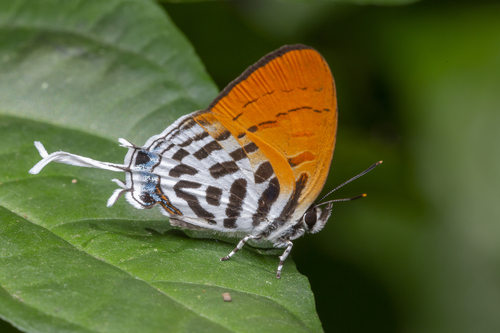
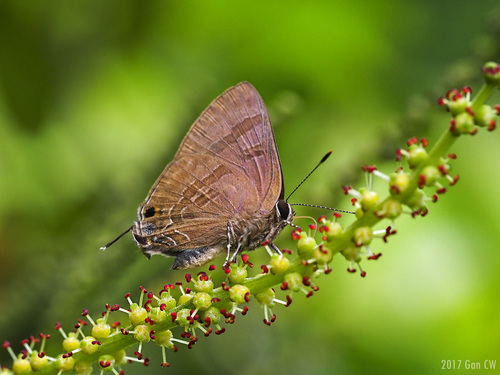
Male. Upperside: dark glossy indigo-blue, with a greenish tint visible under certain lighting. On the forewing, the blue colour blends into the broad black costal and outer marginal borders. On the hindwing, the costal space and abdominal fold are blackish, and the outer margin has a very narrow black band. The abdominal area outside the fold is darker black than the fold itself. The anal lobe is black, with an orange spot and a few greyish-white scales along its upper side; the tail is black, with a white tip. The cilia of both wings are black with pale tips, and a white medial line runs through them from the anal lobe to vein 3. Underside: rufous-brown, with some shade variation between different individuals, and markings are darker brown. On the forewing, there is a bar at the end of the cell, a moderately broad discal band that extends from near the costa to the sub-median vein, slightly curved outward above its middle. In some specimens, a patch of black suffusion connects this band to the discal bar. There is also a narrower sub-marginal band. On the hindwing, there are similar discoidal and discal bands. The discal band is outwardly edged with white, made up of connected squarish spots. It passes close to the lower end of the discoidal bar, and curves slightly outward from the costa to vein 2. At vein 2, it curves inward in a large angle to the abdominal margin a little below the margin’s middle. At this point, the band is prominently edged with white on both sides, and a short white line lies close below it. The anal lobe is black, capped with dull orange, and a white anteciliary line runs along the lower half of the outer margin. Antennae are black, ringed with white; the club has a red tip. The frons is black, and the eyes are ringed with white. The head and body above and below match the colour of the wings, while the underside of the abdomen is ochreous. Female. Upperside: paler than the male, pale brown glossed with purple. As a result, the black costal and outer marginal borders are more distinct. Underside: paler than the male, with the same pattern of markings as the male.