About Ranunculus sceleratus L.
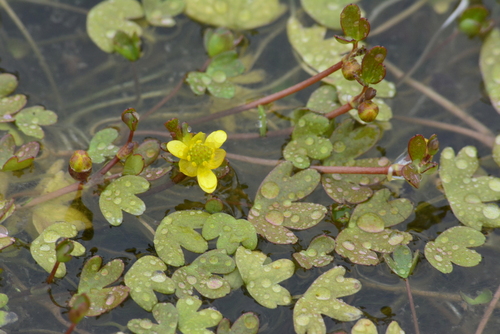
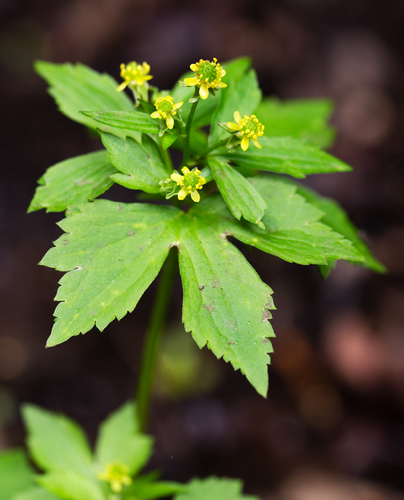
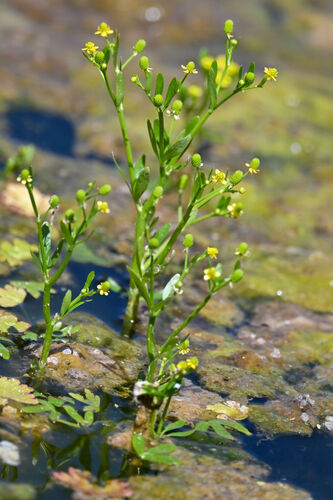
Ranunculus sceleratus L. is an annual herb that grows up to half a meter tall. Its leaves are more or less glabrous, meaning hairless, with small individual blades that are deeply lobed or divided into three leaflets, and the leaves grow on long petioles. Its flowers measure 5 to 10 millimeters across, with five or fewer yellow petals that are a few millimeters long, plus reflexed sepals. The fruit is an achene, borne in a cluster of several achenes. All buttercup species are toxic due to the compound protoanemonin, and this is especially true for cursed buttercup, which is the most toxic buttercup and contains 2.5% protoanemonin. All parts of this plant are considered poisonous. When its leaves are wrinkled, damaged, or crushed, they cause unsightly sores and blisters on human skin. Ingestion of the plant leads to extreme irritation of the skin and mucous membranes, and may cause pain, a burning sensation, tongue inflammation, and increased salivation.
Ranunculus sceleratus has a circumpolar distribution across the northern hemisphere. Two varieties and one subspecies of the species have distinct ranges: R. sceleratus ssp. reptabundus grows in northern Finland and northwestern Russia; R. sceleratus var. multifidus occurs in northwestern North America; and R. sceleratus var. longissimus is found from Minnesota to Alabama, as documented in Minnesota and Alabama's respective biodiversity and plant atlases. This species is also distributed in Australia and New Zealand.