About Ranunculus lyallii Hook.fil.
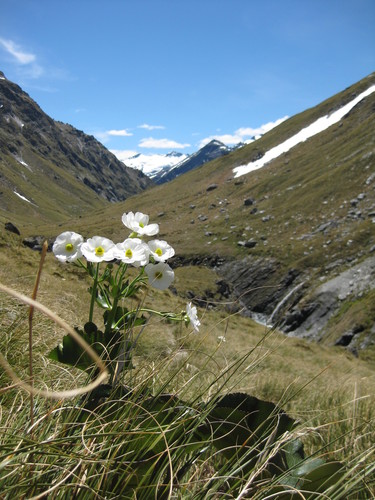
Ranunculus lyallii, commonly called Mountain buttercup, Mount Cook buttercup, or Mount Cook lily (despite not being a true lily), is a buttercup species in the genus Ranunculus. It is endemic to New Zealand, where it grows in the South Island and on Stewart Island at elevations between 700 and 1500 metres. It is the largest known species in the genus Ranunculus, capable of growing over one metre in height.
This species was first discovered by David Lyall, a prominent Scottish botanist and physician who lived from 1817 to 1895. Noted contemporary botanist Sir Joseph Dalton Hooker wrote in his Flora Antarctica: "Among his many important botanical discoveries in this survey was that of the monarch of all buttercups, the gigantic white-flowered Ranunculus lyallii, the only known species with peltate leaves, the 'water-lily' of the New Zealand shepherds." This quote was originally published in 1895 in volume 33 of the Journal of Botany, on page 209.
R. lyallii is a herbaceous perennial plant that grows 60 to 100 centimetres tall, and has a stout rhizome. Its leaves are glossy dark green, peltate, and measure 15 to 40 centimetres in diameter. Its flowers are 5 to 8 centimetres across, with 10 to 20 white petals and numerous yellow stamens; it flowers from late spring to early summer. Well-known locations where this species grows include Aoraki / Mount Cook National Park, other alpine areas of the South Island, and the region around Arthur's Pass.
When referred to as the Mount Cook lily, this flower served as the logo for Mount Cook Airline until it was replaced by Air New Zealand's koru symbol. Other companies connected to the airline also used this logo until the Mount Cook Group was disbanded in 1989. This iconic New Zealand flower has appeared on New Zealand Post stamps as early as 1936, and was featured repeatedly in later decades on stamp sets related to conservation and New Zealand scenery.