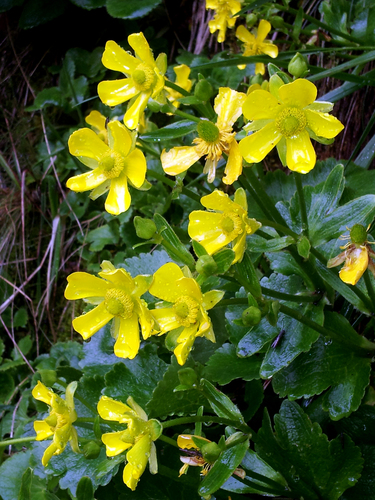
About Ranunculus insignis Hook.fil.
Ranunculus is a large genus of around 1750 flowering plant species in the family Ranunculaceae. Members of this genus are commonly called buttercups, spearworts, and water crowfoots. The genus has a worldwide distribution, and is concentrated primarily in temperate and montane regions. The well-known creeping buttercup, Ranunculus repens, is a widespread garden buttercup native to Northern Europe and introduced to other regions, with very tough, tenacious roots. Two additional widespread species are bulbous buttercup Ranunculus bulbosus, and the much taller meadow buttercup Ranunculus acris. All three species are often considered weeds in ornamental gardens. Buttercups typically bloom in spring, but flowers can appear through the summer, especially when the plants grow as opportunistic colonizers such as garden weeds. Water crowfoots, which belong to Ranunculus subgenus Batrachium, grow in still or running water, and are sometimes classified as a separate genus Batrachium, a name derived from the Greek bátrakhos meaning 'frog'. These plants have two distinct leaf types: thread-like underwater leaves and broader floating leaves. Some species, including R. aquatilis, have a third intermediate leaf type. Larvae of some Lepidoptera species, such as the Hebrew character and small angle shades, feed on Ranunculus species. Some Ranunculus species are popular ornamental plants in horticulture, with many cultivars bred for large, brightly colored flowers. Buttercups occur on all continents except Antarctica, in both the Northern and Southern hemispheres, and are primarily found in temperate or montane habitats. The genus is thought to have originated in northern Eurasia during the late Eocene or Oligocene, then rapidly radiated and dispersed across the globe. Fossil evidence indicates that buttercups grew in Antarctica until the mid-late Pliocene, even as glaciations drastically changed the landscape, although they no longer grow there today. All Ranunculus (buttercup) species are poisonous when eaten fresh. Their acrid taste and the mouth blistering caused by their poison means animals usually avoid eating them. Livestock poisoning can happen when buttercups are abundant in overgrazed fields with little other edible plant growth, and animals eat the plants out of desperation. Poisoning symptoms include bloody diarrhea, excessive salivation, colic, and severe blistering of the mouth, mucous membranes, and gastrointestinal tract. When Ranunculus plants are handled, naturally occurring ranunculin breaks down to form protoanemonin, which can cause contact dermatitis in humans, so care should be taken when handling large amounts of these plants. The toxins break down during drying, so hay that contains dried buttercups is safe.