About Ranunculus adoneus A.Gray
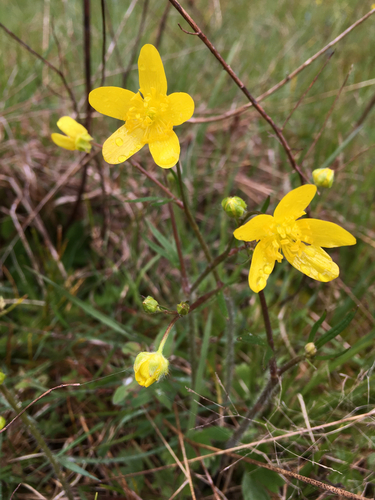
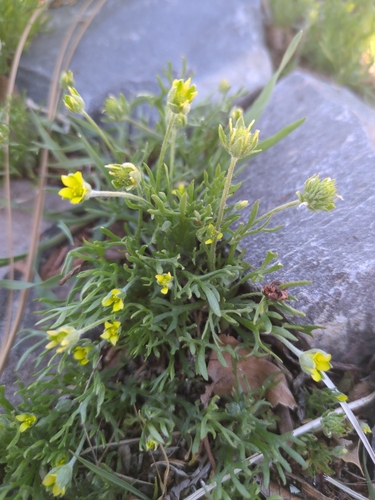
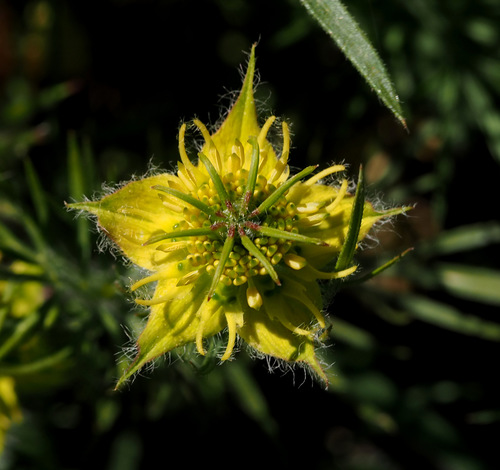
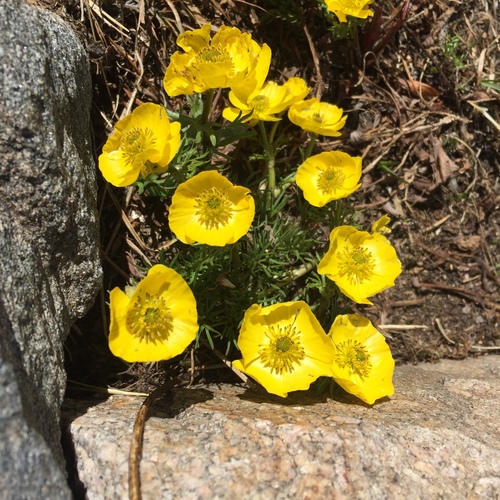
Ranunculus adoneus A.Gray has leaves roughly 4 cm in diameter, deeply dissected into linear lobes. Its narrow leaf segments grow at the plant base and along the stem, and often occur as just one pair. The hairless, fairly thick stem measures 9–25 cm long, growing erect ascending from the root caudices. Each stem bears 1 to 3 yellow flowers, which have 5 to 10 wedge-shaped petals. The flowers are larger than the leaves, measuring around 4 cm across. On young plants, flowers sit low on the stem, and move higher as the stem elongates over the summer. This species has protogynous flowers: pistils mature before anthers do, to prevent self-fertilization. Flowers have 5 greenish-yellow sepals, which bear white hairs on their lower surface. Petals overlap and curve upward toward the tip, giving the flower a cup shape. The receptacle holds 50–150 stigmas, which mature over several days. Fertilized ovules develop into photosynthetic achenes, the seed-containing fruit of this species. Seeds are primarily dispersed by gravity 3 to 5 weeks after fertilization. Ranunculus adoneus is a long-lived perennial native species. It grows only in the Rocky Mountains, near the snow limit, where it is quite common. It inhabits elevated alpine meadows. Plants emerge at the edge of melting snow, and flower within just a few days. Its flowering timing is controlled by the timing of snowmelt. On steep elevation gradients, flowers first appear at lower altitudes, then appear several tens of meters higher as snow melts further up the slope. This species is found at altitudes between 2500 and 4000 meters. Flowering lasts longer at lower altitudes; individual flowers persist for approximately 10 days. Secondary flowers may open one to two weeks after the primary flowers.