About Ranunculus acris L.
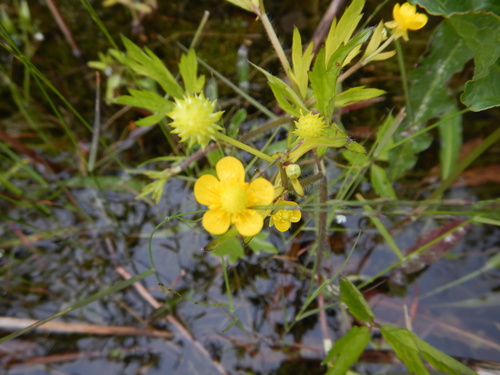
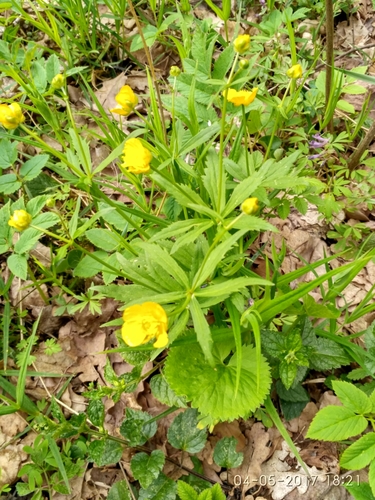
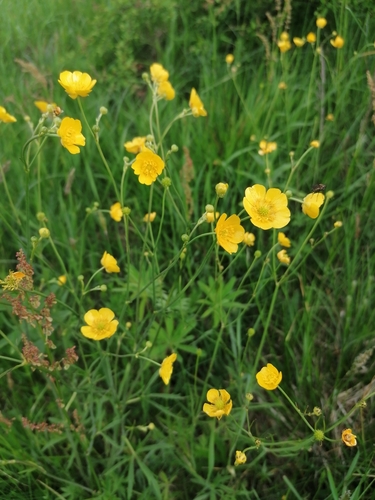
Ranunculus acris L. is a herbaceous perennial plant that reaches 30 to 100 cm (12 to 39 in) in height. It has smooth, ungrooved stems that carry glossy yellow flowers roughly 25 mm across. Each flower has five overlapping petals that sit above five green sepals, which are held upwards against the petals and turn yellow as the flower matures. Numerous stamens grow inserted below the ovary. Its leaves are compound, with finely cut, hairy leaflets; unlike the related species Ranunculus repens, its terminal leaflet is sessile. Like other members of the Ranunculus genus, it produces numerous seeds in the form of achenes. The rare autumn buttercup, R. aestivalis, is sometimes classified as a variety of this species. This plant is native to Eurasia, but has been introduced across most of the world and now has a circumpolar distribution. It is a naturalized species, and often a weed, in parts of North America, though it is probably native to Alaska and Greenland. In New Zealand, it is a serious pasture weed that costs the national dairy industry hundreds of millions of dollars annually, and it is one of the few pasture weeds that has evolved resistance to herbicides. R. acris is a characteristic species of grazed or mown neutral grassland communities. It tends to grow in areas with intermediate drainage conditions, between the drier soils preferred by R. bulbosus and the wetter soils preferred by R. repens. Its abundance is reported to be an indicator of grassland age and continuity, but it does not compete well in species-rich communities dominated by tall grasses. Flower buds begin developing in late summer of the year before the plant flowers. Floral development is encouraged by low winter temperatures, and the plant overwinters as a rosette of small green leaves that appear resistant to frost damage. It reproduces via seeds and short thick rhizomes, which can split to form new daughter plants. Oils found in the plant, likely concentrated in the leaves and stems, contain the glycoside ranunculin. When ingested, ranunculin can cause abdominal pain and intestinal disorders. Consumption of the plant by animals has caused blistering of the tongue and lips, diarrhea, and blindness. Additional symptoms of poisoning include ventricular fibrillation and respiratory failure. The plant's juice is semi-poisonous to livestock and causes blistering. In horticulture, the species is often considered a troublesome weed that colonizes lawns and paths, but it can be a desirable addition to wildflower meadows. The double-flowered cultivar R. acris 'Flore Pleno' has received the Royal Horticultural Society's Award of Garden Merit. Multiple Native American groups have used this plant for medicinal and food purposes. The Abenaki crush the flowers and leaves and inhale the scent to treat headaches. The Bella Coola apply a poultice of pounded roots to boils. The Micmac use the leaves to treat headaches. The Montagnais inhale crushed leaves to relieve headaches. The Cherokee use a poultice of the plant for abscesses, an infusion for oral thrush, and the plant juice as a sedative; they also cook the leaves and eat them as greens. The Iroquois apply a poultice of crushed plant to the chest to relieve pains and treat colds, drink an infusion of the roots to treat diarrhea, and apply a poultice of the plant mixed with another plant to the skin to treat excess water in the blood.