About Ranoidea xanthomera (Davies, McDonald & Adams, 1986)
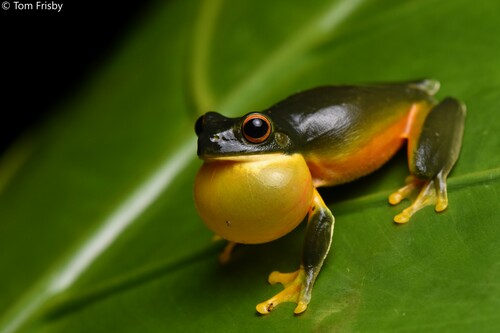
The orange-thighed frog (Ranoidea xanthomera) is a medium-sized slender tree frog that reaches a length of 5.5 cm (2.2 inches). It has a thin body, a flat head, and large orange-coloured eyes. Its dorsal surface is green, while its feet and vocal sac are bright yellow, and it has a yellow band running down its flank. The inner surfaces of its legs are yellow, and the outer leg surfaces are green. It can be physically distinguished from the red-eyed tree frog by its bright-orange thighs, as red-eyed tree frogs have mauve thighs. For ecology and behaviour, male orange-thighed frogs gather around still ponds, and call from low branches or the edges of the water. Their call is a long "aaa-rk" followed by a soft trill, and they call after heavy monsoon rains. Males call in large choruses, amplexus takes place at the location where the male calls, and then the male and female move to the egg-laying site. The eggs are brown, and are laid in masses of 800 to 1600. The tadpoles of this species are identical in appearance to the tadpoles of the red-eyed tree frog. The orange-thighed frog lives in dense rainforest.