About Ranoidea rheocola (Liem, 1974)
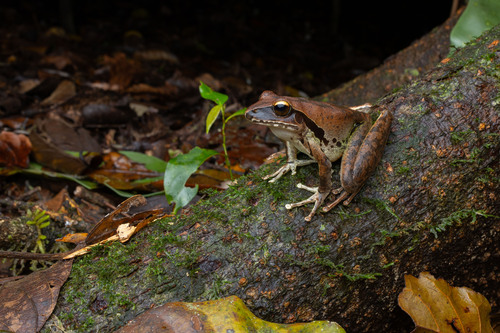
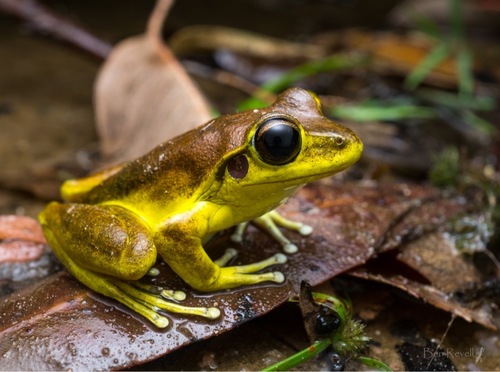
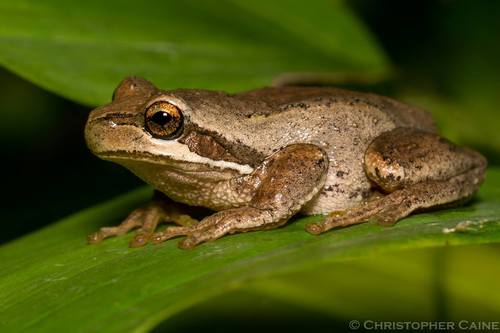
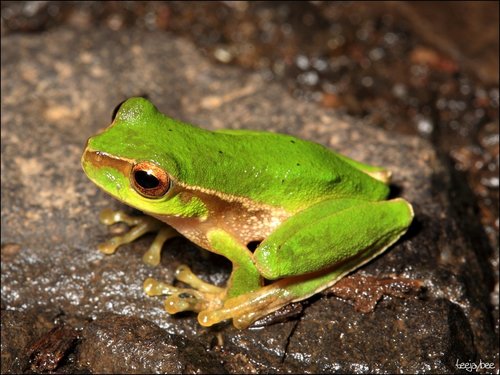
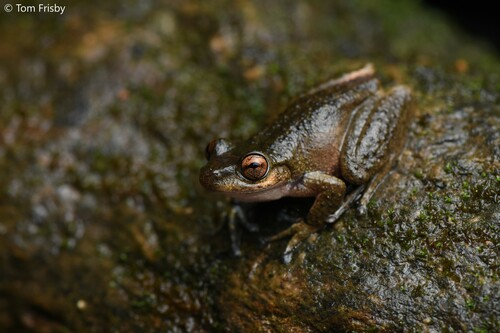
Fully grown common mist frogs (Ranoidea rheocola) measure 27 to 41 millimeters in length and typically weigh between 1.2 and 4.5 grams. This species displays sexual dimorphism, with females growing larger than males: on average, males reach around 31 mm in length and 2.0 grams in weight, while females average 36 mm in length and 3.1 grams in weight. Common mist frogs have a dull grey or brown dorsal surface covered in small rounded protrusions called tubercles, marked with dark, irregular patterns. Their underside has granular, white skin, and most individuals have a distinct line running between their eyes. Their fingers are partially webbed, with webbing extending to the second-subarticular tubercle at the end of the first phalanx, while their toes are fully webbed. Both fingers and toes bear large discs. The tympanum, or outer ear, is covered by a thin layer of skin but remains visible. The species has a relatively slender body, a protruding triangular snout with a pointed tip, and obscure dark bands running along the side of the snout from the eye and ear to the shoulder. Males have small nuptial pads and do not have enlarged arms, unlike other male torrent treefrogs. Common mist frog tadpoles are flat-bodied torrent-dwellers with large mouthparts, large suctorial mouthparts, and muscular tails that help them swim against currents; they use their mouthparts to cling to nearby rocks. The common mist frog's mating call is a regular, repeated, long-drawn single nasal note, described as "wreek wreek wreek". Calls have a low average dominant frequency of around 2.5 kHz. The common mist frog is found throughout the Wet Tropics of Queensland, Australia, ranging from north of Ingham to Big Tableland south of Cooktown, and from Broadwater Creek National Park to Amos Bay in northern Queensland. It inhabits the riparian zone of fast-flowing streams in rainforests and wet sclerophyll forests of eastern tropical North Queensland. It occurs primarily along rainforest streams near riffles, cascades, and waterfalls, but also lives in wet sclerophyll forests and similar streamside microhabitats outside of rainforests. Individuals have been observed perching on vegetation, rocks, logs, and roots along streams, and can be found in piles of leaves beside flowing streams during the day. Historically, the species occupied areas from sea level up to elevations of 1200 meters; since 1990, it has not been recorded above 600 meters, and is rare in habitats above 400 meters elevation. Its current total area of occupancy is restricted to approximately 6000 square kilometers. Breeding occurs year-round, with peak male calling during the warmer Australian summer between November and March, as males are typically quieter in colder temperatures. Males call from rocks and vegetation around streams and creeks. To improve the chance of successful mating, males practice inter-male spacing: they spread out, and are rarely observed less than one meter apart. This spacing is likely a territorial response to low female population density, and is thought to prevent interference with other males' mating attempts. Like other torrent treefrogs, males have spinose nuptial pads that help them grasp females during mating. After mating, females deposit clutches of 46 to 63 large, uncolored eggs in gelatinous masses under rocks in fast-flowing water, an placement that prevents eggs from being washed away by the current. The stream-dwelling tadpoles use their suctorial mouthparts to survive in fast-flowing water, hatch among rocks in riffles, and feed on algae.