About Ranoidea raniformis (Keferstein, 1867)
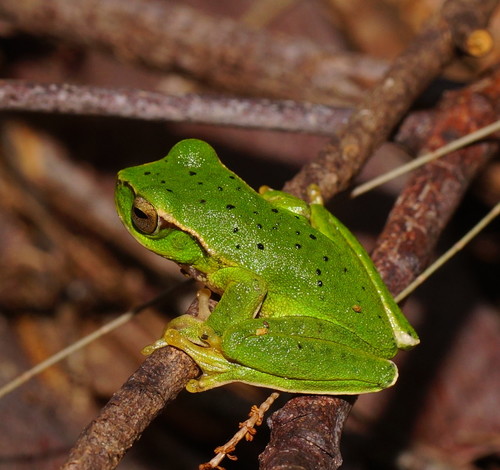
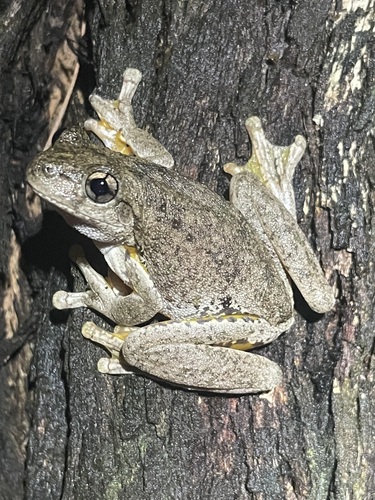
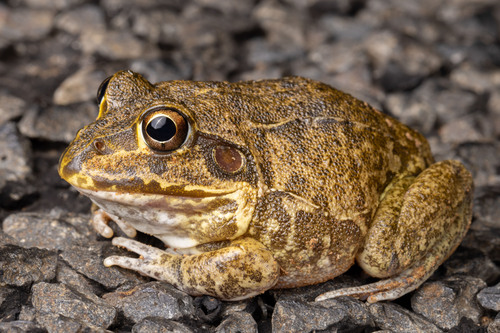
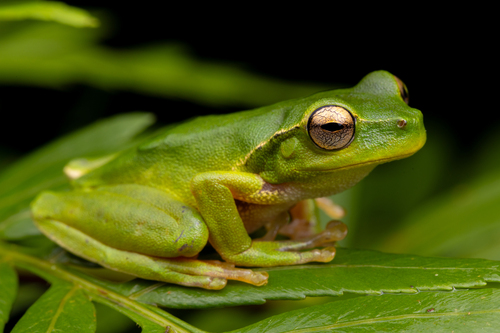
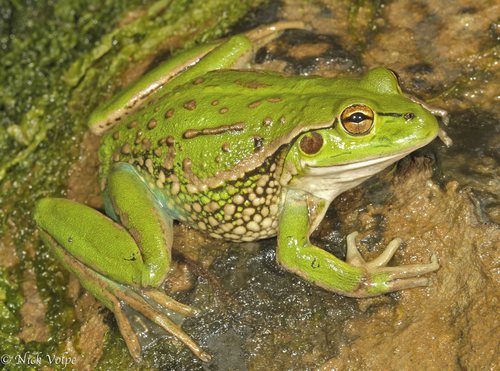
Description: The growling grass frog, Ranoidea raniformis, is a very large, ground-dwelling tree frog that reaches up to 10 cm (almost 4 in) from snout to vent. Its dorsal surface is mottled bright green and bronze, and often marked with dark brown enameled bumps. The frog has a pale cream underside with a faint cobbling pattern. A pale stripe runs as a skin fold from the side of the head down the flanks, and its thighs are blue-green. A series of shallow bumps covers its back. This species closely resembles the green and golden bell frog (Ranoidea aurea), but can be distinguished by the shallow back bumps, a shorter call, and a slightly different head and snout shape. The tympanum is visible in growling grass frogs. Tadpoles of this species are also very large, reaching up to 9.5 cm (3.7 in). They typically have coppery pigment along their sides and an iridescent green sheen along their backbones.
Distribution: This species is native to southeastern Australia, and also occurs in Tasmania. It was introduced to New Zealand in 1867 by the Canterbury Acclimatisation Society, and has since become widely distributed across both the North Island and South Island. An additional population established in the Adelaide Hills from pet trade releases in the 1990s, but this population is now extinct.
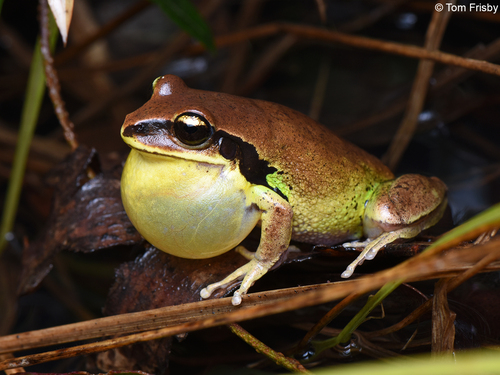
Ecology and behaviour: Ranoidea raniformis is associated with large swamps, permanent dam impoundments, ponds, and lakes—especially those with reeds—in woodland, shrubland, open, and coastal areas. It is an agile climber, but is most often found among dense reeds or along swampy grasslands. It hunts and basks in the sun during the day. Reportedly, growling grass frogs hunt other frogs by moving toward the sound of other frogs' calls. Its call is a three-part moaning "craw-ork ar-ar", with a tone that rises then falls; the call has been described as sounding like a duck or goose being strangled. During the breeding season, which runs from spring through to late summer, males develop black, rough nuptial pads on their thumbs. When threatened, females are able to produce a hissing sound. Females can lay up to several thousand eggs, which are distributed in a loose pile. The tadpole stage lasts approximately 12 weeks. The species has declined across much of its native range, and has disappeared completely from some regions, including the Australian Capital Territory and the lowest 200 KM of the River Murray. Several populations along the River Murray have been stabilised through regular managed water delivery to breeding locations, such as in the Lower Murrumbidgee catchment in New South Wales and the Riverland region of South Australia. Growling grass frogs are regularly recorded in suburban Melbourne and Geelong, with similar records from regional Australian cities.