About Ranoidea platycephala (Günther, 1873)
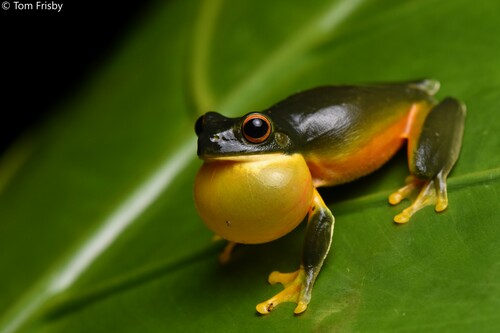
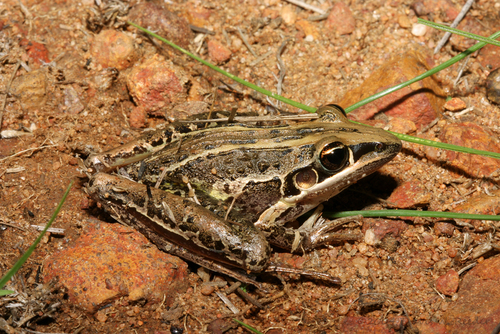
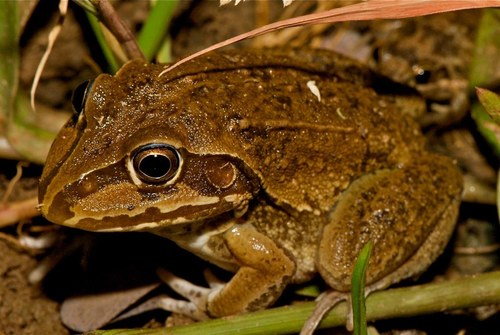
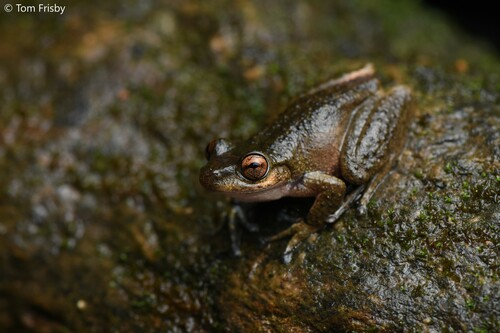
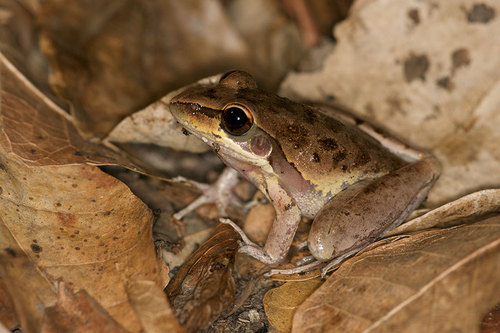
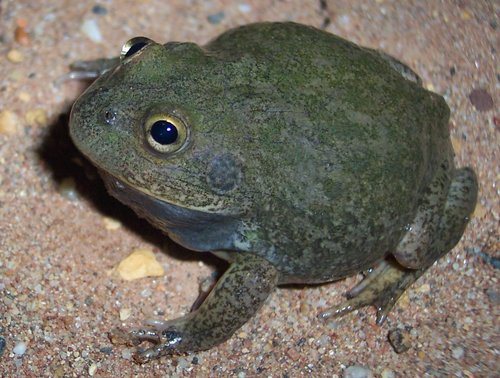
Ranoidea platycephala, commonly called the water-holding frog, has a broad, slightly flattened head that is wider than it is long. Its eyes are tilted dorsally and sit prominently on the top of the head, a trait that distinguishes it from similar species and improves its downward vision and binocular perspective. This frog has short arms and hindlimbs, with extensively webbed toes that increase foot surface area to let it swim quickly underwater while hunting prey or escaping predators. A small, shovel-like metatarsal tubercle is present on the underside of each back foot, which the frog uses for digging. The species has a thick body, with base colouration ranging from olive, dull yellow and grey to dark brown, and it has a white underbelly. Colour varies across different population ranges and habitat types; some individuals have smooth skin, while others have more granular, finely speckled skin. This varied colour works as effective camouflage against predators. Adult water-holding frogs can grow up to 75 millimetres in length. Newly hatched tadpoles of this species are translucent gold, with alternating gold and black patches along their tail muscle. As tadpoles grow, gold pigment increases across their dorsal side, and fades to opaque silver on the sides and underside of the body. Tadpoles can reach a maximum length of 60 to 70 millimetres. Ranoidea platycephala is endemic to Australia, and occurs in all Australian states and territories except Victoria and Tasmania. The species is distributed across dry inland regions in two separate allopatric populations: the first is found on the Barkly Tablelands of the Northern Territory, and the second spans north-eastern South Australia, southern Queensland and northern New South Wales. It lives in arid and semi-arid regions, and is the most widely distributed frog species in these habitat zones. It occupies a range of habitats that are thought to be low-elevation and prone to flooding, including ephemeral wetlands, scrublands, forests, grasslands, claypans, temporary swamps, intermittent pools, and rivers. Based on frequent reports and its broad range, the species is assumed to have large populations. Its range overlaps with existing national parks, but only limited research has been done on the species' ecology and biology. Females of Ranoidea platycephala reach sexual maturity when they grow to 48 to 50 millimetres in length, while males reach sexual maturity (with mature sperm) at the smaller length of 34 millimetres. Breeding begins after spring and summer rainfall, when the frogs emerge from their burrows. On the same evening they leave their burrows, males begin calling to attract mates while either submerged or floating in water. Their mating call is described as sounding like a motorbike starting, ending with a long, drawn-out "mawww" sound. Breeding typically takes place in warmer months in ephemeral wetlands after rainfall. After mating, females release up to 500 eggs when spawning in still water. The eggs are not held together in a frothy mass; they may attach in clumps to nearby vegetation, or spread in a thin film across the water surface, which ensures they get adequate oxygen in warm water with low oxygen levels. Tadpole metamorphosis usually takes around 40 days, but can occur in as few as 14 days. Once tadpoles reach their maximum length, they begin to store abdominal body fat. Research on gametogenesis in the water-holding frog has shown that females do not release all their eggs at once, and can store unspawned eggs over winter. It also confirmed that males have mature sperm year-round; sperm production is continuous, but slower in winter. The ability to store and continuously produce gametes is an advantage for this species, since the timing and duration of rainfall is unpredictable. Breeding is not common in winter, but may occur if conditions are suitable.