About Ranoidea nannotis (Andersson, 1916)
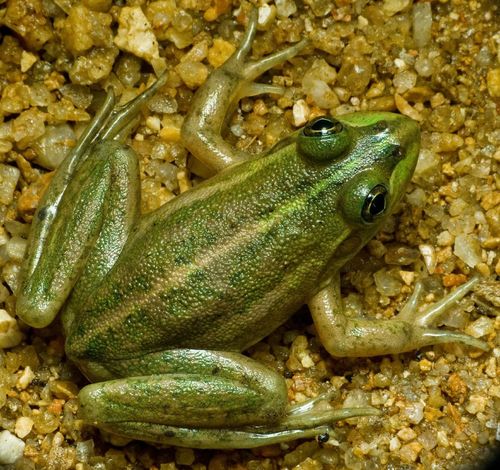
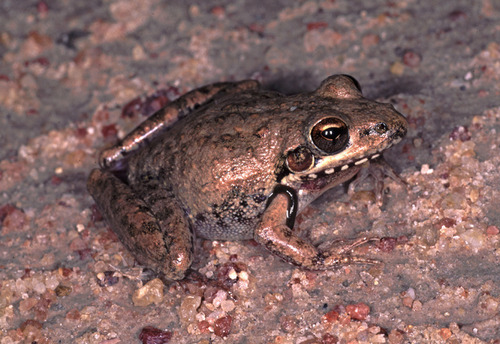
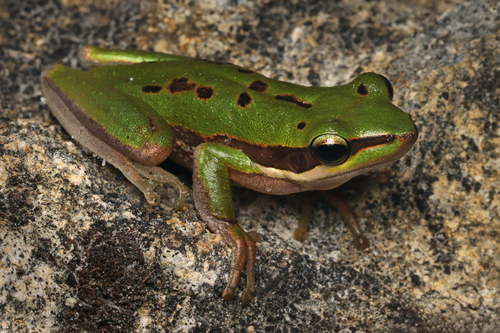
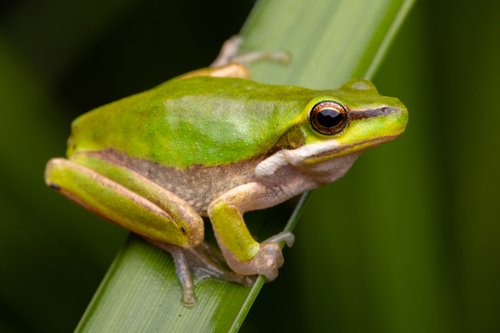
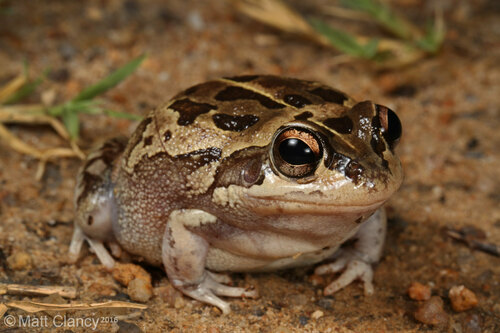
This species, commonly called the waterfall frog, can reach 5.5 cm in length, making it a large frog. Its dorsal surface is mottled dark brown, and its back patterning matches its surrounding habitat, letting it camouflage effectively against granite. The ventral surface is granular and colored with bright orange, green, and pink; the posterior ventral surface is translucent, so internal body parts are visible through it. Compared to the width of its toes, the toe pads of Ranoidea nannotis are very large. This trait helps the frog grip onto rocks in rushing rapids. Breeding males have large nuptial pads that cover the entire inner surface of the thumb, and spines are also present on the males' arms and chest. This species does not have a visible tympanum. Its fingers are partially webbed, while its toes are fully webbed. Like the stoney creek frog (Litoria wilcoxi) and many other stream-dwelling frog species, waterfall frogs do not have vocal sacs. This lack of vocal sacs is likely because the noise of a running stream drowns out any frog calls, so developing and using vocal sacs would be a waste of energy. The waterfall frog is a stream-dwelling frog native to tropical north Queensland, Australia. Its native range extends from Paluma to Cooktown, and it is notable in the uplands of Mt. Carbine. It occurs at altitudes ranging from 180 m (590 ft) to 3,000 m (9,840 ft). Many of this species' high-altitude populations have experienced large declines, and many high-altitude populations are now completely extinct; this decline is likely caused by chytridiomycosis. Populations of the waterfall frog in lowland areas are currently stable.