About Ranoidea moorei (Copland, 1957)
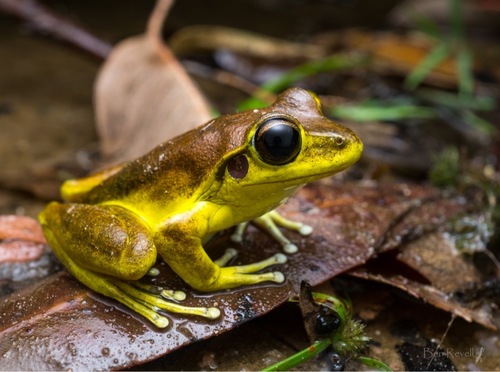
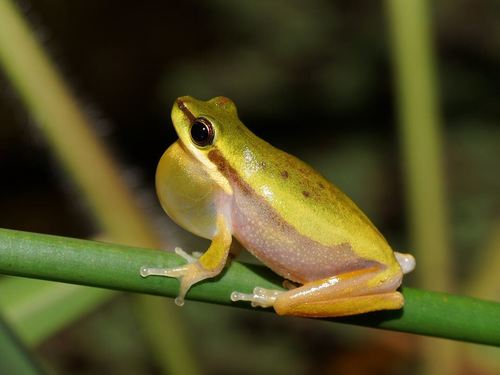
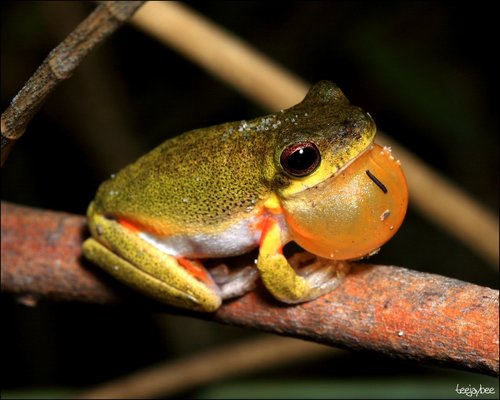
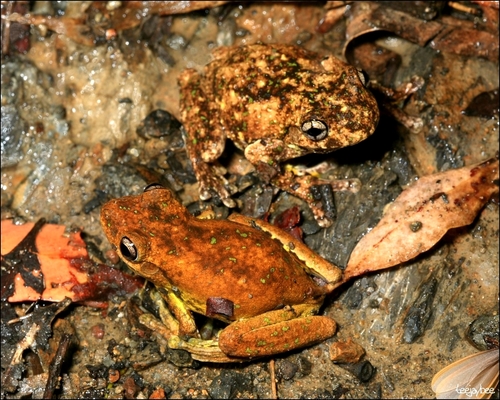
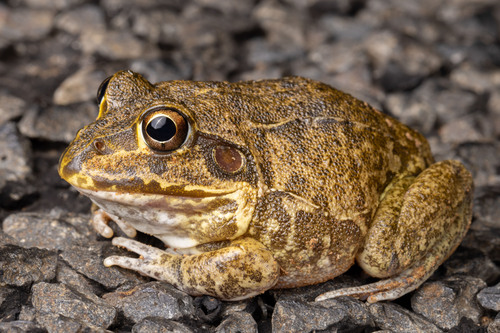
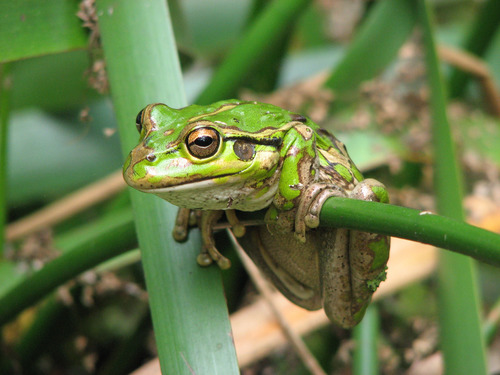
Ranoidea moorei is a species of tree frog that is very good at camouflage. Its dorsal color ranges from dark brown, through green, to gold, and its underside is noticeably lighter, usually from very pale green to light brown. The light green coloration of its groin and thigh distinguishes this species from its congener, Ranoidea cyclorhynchus, which has darker, yellow-spotted coloration in that area. Like other typical tree frogs, its toe pads let it climb smooth vertical surfaces. It has powerful hind legs and webbed toes. During the mating season, males develop black nuptial pads that help them cling to the backs of females during amplexus. Adult R. moorei can reach up to 7.5 cm in length.
The body of R. moorei tadpoles is uniform dark brown on top with a silvery sheen on the underside. Tadpoles are extremely small when they hatch, and grow to a maximum length of 80 mm. Tadpoles usually hide among aquatic vegetation, but will readily leave hiding when food is available. For most of their tadpole stage, they gather in large crowded schools.
This species is found in the south-west corner of Western Australia, ranging north to the Geraldton Sandplains and south to the Esperance Plains on Western Australia's south coast. A population also exists on Rottnest Island, and it is one of the best-known frog species in urban Perth areas. Its estimated altitudinal range is 0 to 600 meters above sea level. It has a wide, populous distribution across natural lakes and swamps, and has readily adapted to using garden ponds and farm dams as habitat. It is often found sunbathing on the upper leaves of plants.
The breeding season for R. moorei runs from early spring to late summer. The male's mating call sounds like a motorbike changing gears. Males typically call from a suitable clump of reeds or other water plants. When a female joins the male in the water, the male grips onto the female's back using his breeding-season nuptial pads. Females lay large egg clumps encased in transparent jelly, which are attached to floating vegetation and debris.
Despite being a tree frog, R. moorei rarely climbs higher than 1 to 2 meters, on plants, shrubs, brick walls, or windows. The diet of adult frogs consists mainly of arthropods, but also includes smaller frogs, even juvenile members of their own species. Tadpoles eat mostly algae, but will also consume animal matter when it is available. Like adult frogs, tadpoles sunbathe for one to two hours each day to support healthy growth. R. moorei can survive without water for extended periods of time.