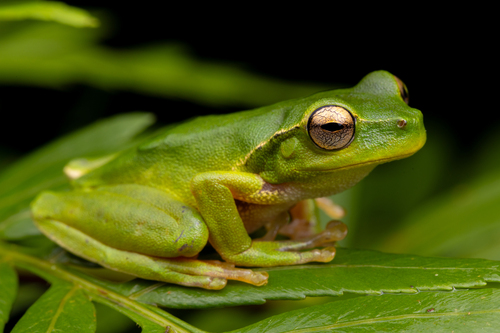
About Ranoidea gracilenta (Peters, 1869)
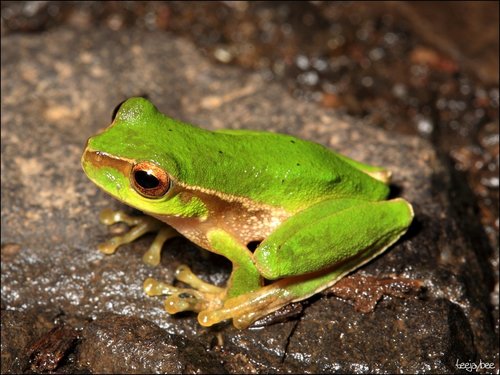
The dainty green tree frog, with the scientific name Ranoidea gracilenta (Peters, 1869), is a slender, medium-sized frog that reaches a maximum length of 45 millimetres (1.8 in). Its dorsal surface is rich green, while its ventral surface is yellow. It has coarse, granular skin and bright orange eyes; some individuals have a light blue ring circling the eye. The back of the thigh is purple-brown or maroon, and the tympanum is visible. In most specimens, a thin yellow or white line runs from the nostril to the eye; this line is absent in the closely related red-eyed tree frog (L. chloris) and orange-thighed frog (L. xanthomera), which distinguishes Ranoidea gracilenta from these species. When this distinguishing line is absent, Ranoidea gracilenta can still be separated from the two related species by its smaller size and the granular texture of its dorsal skin. The fingers of Ranoidea gracilenta are three-quarters webbed, and the toes are fully webbed. This frog species is commonly found in vegetation that emerges from the water of streams and swamps, often in temporary water bodies. It inhabits a range of environments, including rainforest, woodland, and forest. It is frequently found near human developments, such as gardens or farms, and often enters houses to hunt for insects. Because it is commonly found on fruit and vegetable farms, particularly banana farms, it is often transported around Australia along with harvested fruits or vegetables, and frequently becomes separated from its native range as a lost frog. This accidental transport occurs in many frog species, and it is a concern because it allows disease to spread much more quickly than it would naturally. This species is usually spotted after heavy rain in spring and summer. It breeds in flooded grassland and small ponds. Males call during summer after rain; their call has been described as a long "waa", "wee", or a long, growl-like 'aarrrc' that is repeated frequently. During the summer breeding season, males gather to form loud breeding choruses. Eggs are laid in a clear jelly mass in water, and are attached to vegetation. Tadpole development takes approximately 14 weeks. Tadpoles are dark brown, with a clear yellow tinge on the body wall.