About Ranoidea aurea (Lesson, 1829)
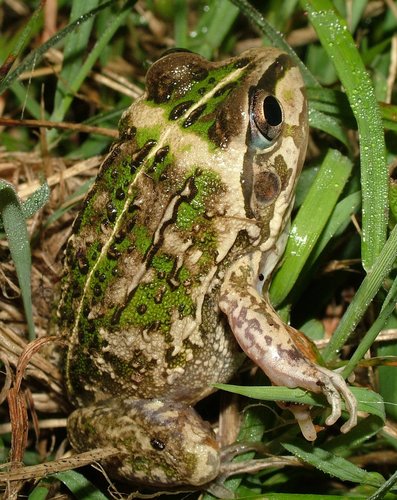
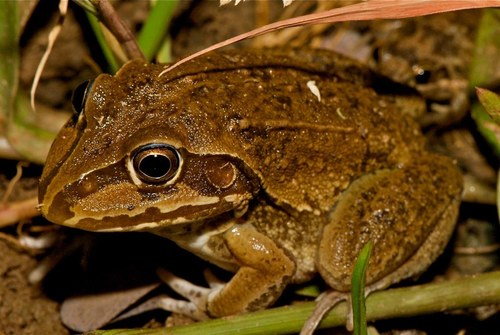
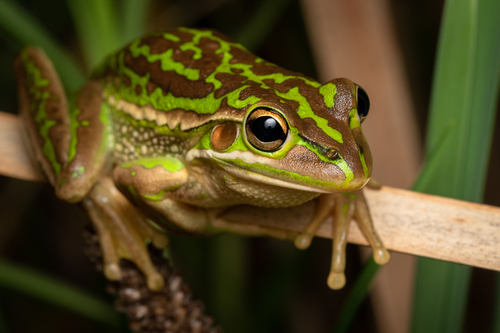
The green and golden bell frog, scientifically named Ranoidea aurea (Lesson, 1829), is a large, stout frog species and one of the largest frogs native to Australia. Adult individuals measure 4.5 to 11 cm (1.8 to 4.3 in) in total length, with most typical specimens ranging from 6 to 8 cm (2.5 to 3 in). Mature males are generally smaller than mature females, and their dorsal coloration differs noticeably from females. Dorsal color can range from almost any shade of green—from dark pea-green to bright emerald—to solid bronze, and may also appear as green marked with metallic, brassy, dull copper-brown, or gold patches. Females generally have more green patches on their backs than males. During the inactive cooler months from May to August, the frog's color may darken to nearly black; it can also darken this way after staying in a dark location for just a few minutes, and its color can change over the course of its lifetime. A creamy-white or pale yellow stripe, bordered by gold along its upper edge and black along its lower edge, runs from behind the eye, across the typically copper-colored eardrum (tympanum) all the way to the groin. This stripe forms a raised dorsolateral fold near the groin. A second stripe of the same creamy-white or pale yellow color starts below the eye and extends to the shoulder. The abdomen is cream or white with a coarsely granular texture. The legs are green, bronze, or a mix of both, and the inner thigh and groin are blue-green. Mature males develop yellowish coloring on the vocal sacs on their throat. The tympanum is clear and oval-shaped, and the species has enlarged toe discs that help with climbing. Since this species often lives near or in water, its fingers have no webbing, while its toes are almost completely webbed. When breeding season arrives, males develop brown nuptial pads on their thumbs to grip females during mating; these pads are pale and inconspicuous outside of breeding season. During the breeding season, females develop a blueish tint on their feet, while males' legs turn rusty orange. The green and golden bell frog is native to southeastern Australia. Before its population declined, its range extended from Brunswick Heads in northern New South Wales to East Gippsland in Victoria, and west as far as Bathurst, Tumut, and the Australian Capital Territory. Its current distribution extends from Byron Bay in northern New South Wales to East Gippsland in Victoria, with most populations located along the coast. In New South Wales, the species has experienced severe declines in both range and population abundance since the 1960s, while no similar declines have been recorded in Victoria. It has disappeared from all highland areas above 250 m (820 ft) in New South Wales, with the exception of one population in Captains Flat. A study of coastal New South Wales populations found most populations are very small, usually holding fewer than 20 adult individuals. A 1996 study documented only six populations with more than 300 individual frogs: two in the Sydney metropolitan area, two in the Shoalhaven, and two on the New South Wales mid-north coast. The species is now found at only around 40 total sites, most of which are in the Sydney area. It has disappeared from an estimated 90% of its former range. A reported occurrence of the species in Armidale was later confirmed to be a misidentification of R. castanea. Declines in Victoria have been smaller, and are mostly limited to inland areas where habitat has been lost. The green and golden bell frog still survives in parts of Sydney, including the Brickpit at Sydney Olympic Park, which was originally proposed as the site for the 2000 Sydney Olympics tennis courts. When the frog population was discovered there, the tennis courts were constructed elsewhere, and the population has been monitored ever since. This frog has become an unofficial mascot for the Homebush Bay area. Introduction attempts to other Sydney locations within its natural range have not been very successful. The species is also found on three islands off Australia's east coast: Kooragang and Broughton Islands off Port Stephens, and Bowen Island at Jervis Bay. It was introduced to New Zealand in the 1860s by the Auckland Acclimation Society; it is now common in the part of the North Island north of Rotorua, and can also be found in South Taranaki and isolated areas of Southland near Te Anau. In most of these areas, it is the only frog species present. Recent population declines in New Zealand have been reported, which are suspected to be caused by predatory fish. It was also introduced to the Pacific island nations of New Caledonia and Vanuatu in the 19th century, and has become common in both countries. There is no noticeable difference in size or appearance among green and golden bell frogs from different geographic regions. Fluctuations in size and appearance between different populations are smaller than the variation found within individual populations. Females are more likely to be found away from breeding sites, while males are more often found near breeding sites. Newly metamorphosed frogs have an approximately even split between males and females, and juvenile frogs are spotted less often than mature adults, though researchers are unsure if this is due to lower numbers or greater reclusiveness. As a member of the tree frog family, the green and golden bell frog spends much of its time basking in the sun on vegetation, rocks, and reeds, usually close to water, or hopping between these spots. Unlike most frog species, it is often active during the day. When handled, the species secretes a slimy, acrid mucus that contains 17 aurein peptides, 13 of which have broad-spectrum antibiotic and anticancer activity. The secretion makes the frog slippery and hard to grip, and is poisonous to some other frog species, making it a useful defensive adaptation. Males often fight each other if they come within 1 meter of one another, and fights frequently result in injuries. The green and golden bell frog can live in a wide variety of habitat types, and is generally associated with coastal swamps, wetlands, marshes, dams, ditches, small rivers, woodlands, and forests, but populations have also been found at former industrial sites such as the Brickpit. It has even been found in human fixtures like bathtubs. Its habitat requirements are hard to pin down, as it has been found in a wide range of water bodies with the exception of fast-flowing streams. It is most commonly found in still, shallow, unshaded, unpolluted short-lived freshwater ponds, and tends to avoid water that contains predatory fish, both native and introduced. Even so, it is most often found in areas altered by human settlement. The frog prefers water bodies with emergent vegetation such as reeds and bullrushes for basking. In winter, it shelters in available spots around the breeding site, which can include vegetation, rocks, rubbish, or human debris and discarded building materials. Medium to highly dense grassy habitat is usually present nearby to provide suitable terrestrial feeding grounds. It prefers waterways with a sand, rock, or clay substrate, and can tolerate a wide range of water turbidities, pH levels, oxygen levels, and temperatures, though extreme conditions can slow its physical growth. Although its legs give it strong grip, the frog does not climb trees or live in them to any significant degree. It spends most of its time within 10 centimeters of the ground, and rarely goes more than one meter above ground. The green and golden bell frog can stay still for several hours at a time. Green and golden bell frogs can travel long distances in a single day or night, with recorded distances of 1.0 to 1.5 km. Tagging experiments have shown some individuals can travel up to 3 km in total, and some travel several kilometers away from the nearest breeding habitat. Even so, the species tends to return to or stay at a known site if the habitat still meets its needs; it will move away only if the habitat becomes unsuitable. The green and golden bell frog prefers areas with high habitat complexity, which is a core consideration for habitat-based conservation strategies for the species. In general, individual frogs stay within a home range of 100 to 700 square meters. The frog is well-adapted to survive on land. It can rehydrate by absorbing moisture through its ventral skin, and it has watertight skin that leads to a very low rate of evaporative water loss. Some individuals have been observed up to 400 m from the nearest body of water. During winter, the frog is mostly inactive and stays in one spot, while it moves around to search for food and mates in warmer months. It may become active for brief periods during winter when the weather is warm or wet. Based on observations of uncovered individuals in a torpid state, it is thought that the frogs hibernate in cold conditions, but this has not yet been confirmed by rigorous physiological studies. Although the frog is active during the day, this activity is mostly limited to leaving its shelter to sunbathe. It does not generally actively feed or forage during the day, and only hunts insects that come into its immediate vicinity. The reproduction of the green and golden bell frog depends on water salinity and temperature. Salinity affects tadpole development and metamorphosis, and breeding slows significantly in ponds with water temperatures of 20 °C (68 °F) or lower. Tadpoles can tolerate salinity levels of six parts per thousand (ppt) without any visible negative effects, while salinity of 8 ppt or higher reduces growth rates and increases mortality. On the other hand, salinity levels of at least 1 to 2 ppt can benefit the green and golden bell frog, as this kills pathogens such as the chytrid fungus. Pond pH between 4 and 10 does not affect the likelihood of eggs hatching. The green and golden bell frog breeds during the warmer months from October to March, though some early breeding events have been recorded at the end of winter. Breeding timing is influenced by geography; more southerly and highland populations have a shorter breeding window than more northerly and lowland populations, which start breeding earlier and end later. During the breeding season, males call to attract mates, usually while floating on water, though sometimes while on vegetation at the edge of a pond, and calling occurs mostly at night. Their call is a deep growl described as a four-part "walk-walk sound", similar to the sound of a motorbike changing gears. Males respond to recorded calls, which is why entire groups of males will call in unison. Males are most likely to call within specific temperature ranges: 16 to 23 °C for water temperature, and 14 to 25 °C for air temperature. Calling is also most common immediately after rain. Males reach sexual maturity when they grow to around 45 to 50 mm, at an age of between 9 and 12 months; at this size, they develop a grey to brownish yellow wash under the chin, indicating the vocal sac has developed and they are able to call. Females reach sexual maturity at two years of age; females smaller than 65 mm have never been observed in amplexus, and this length is not reached until the second breeding season after metamorphosis. The green and golden bell frog is not a semelparous species (it does not breed only once in its lifetime). Females can lose up to 26% of their body weight when spawning, and males also lose weight during breeding because they eat less. The weight lost during breeding is typically regained between January and September. Amplexus (mating) between males and females mostly occurs in water, but can sometimes happen on dry land far from water. Observations at breeding sites show males stay in the courting area for much longer, while females stay elsewhere to feed before coming to the courting area to mate. During amplexus, males climb onto the female's back and grip her near her armpits. In the wild, amplexus usually lasts between 10 minutes and five days. Artificially induced amplexus in laboratories has been observed to last 50 hours, though reports of amplexus lasting five days exist. Sometimes amplexus does not result in eggs being laid. The frogs may move up to 100 m during amplexus before the female lays her eggs. During egg laying, the pair remains in amplexus, and the male fertilizes the eggs with his sperm. Males paddle their back legs during this process, which researchers suspect speeds up fertilization. The entire egg laying and fertilization process takes around five minutes. On average, females deposit 5,000 eggs within aquatic vegetation in a gelatinous mass; the largest recorded clutch contained 11,682 eggs. The female moves around while depositing eggs, leaving a trail of eggs that sometimes becomes tangled. Initially, the egg mass floats, but it sinks within 12 hours of being laid, or if it is disturbed. The eggs of the green and golden bell frog are distinct from those of other frog species: they are 2 to 2.5 mm wide when laid, and are bicolored, with one end black and the other white. They begin to expand immediately after being laid, quickly growing to around 4 mm across before sinking. When first laid, they float with the black end facing upward, but their orientation becomes disorganized after sinking. Tadpoles hatch two to five days after eggs are laid, though hatching can take as little as a few hours in some cases. The hatching rate ranges between 46% and 77%, and peaks at 22 °C. Hatching is less likely in acidic water, but alkaline conditions do not lower hatching rates compared to neutral conditions. Since each female lays a large number of eggs but mature frogs are scarce, the survival rate of tadpoles is believed to be very low. When they first hatch, tadpoles have a snout-vent length (SVL) of around 2.5 to 3 mm, and a total length including the tail of 5 to 6 mm. In captivity, tadpole total length grows exponentially; their SVL increases from about 3 mm to about 9 mm within five weeks, and triples again in the next five weeks. Overall, the growth rate is 0.2 mm per day in the first five weeks. Green and golden bell frog tadpoles can grow up to 80 mm (3.1 in) long, though size varies greatly and most are much shorter. The tadpole body is roughly as wide as it is deep. The tail fin has a yellow tint and is noticeably arched. The tail musculature is moderate and tapers to a fine point, as does the fin. The body wall is translucent yellow with darker areas over the abdomen. Just before the tadpole develops limbs, it starts to grow the greenish coloration seen in adult frogs. Tadpoles usually swim within 30 cm of the water surface, or stay stationary at the bottom. They often group together in schools similar to fish schools. Towards the end of the tadpole stage, hind legs develop, followed by front limbs, and the tadpole stage ends once the front limbs are fully developed. This normally occurs between October and April matching the breeding season, but tadpoles have been found in the wild year-round, suggesting some tadpoles overwinter; this overwintering has also been observed in captive tadpoles. The length of the tadpole stage, in both the wild and captivity, is usually between 10 and 12 weeks, but can range from five weeks to a year. Slower-growing tadpoles usually develop through the winter, as growth rates are positively correlated with temperature. Variation in growth rate across pH values of 4, 7 and 9 is not significant. In the first four weeks, growth rate does not vary significantly across the 18 to 26 °C temperature range, but after four weeks, growth is significantly slowed at 18 °C. At the start of the metamorphosis stage, all limbs are fully developed, and a tail is still present. During metamorphosis, the tail is resorbed, and the only other visible change is the closure of the spiracle. Metamorphosing tadpoles usually have a SVL of 22 to 28 mm, and will complete metamorphosis between two and 11 months, depending on water temperature and available food. The process is slowed at low temperatures, but generally takes between three and eight days after the tadpole stage is complete. Breeding occurs in a much higher proportion of sites that have no predatory fish, and where water bodies are ephemeral (short-lived) rather than permanent. However, populations in Victoria have been observed breeding in permanent ponds just as readily as in ephemeral ponds. Newly metamorphosed frogs resemble adult frogs and average around 2.6 cm (1.0 in) in length. Recently metamorphosed frogs quickly leave the breeding site, especially if foraging habitat is nearby; they leave less often if food is not available away from the breeding area. This migration tendency is often attributed to cannibalism, with larger frogs preying on developing young. After metamorphosis is complete, the frog's length stays roughly the same initially. Juveniles grow quickly at first, reaching 45 mm within two months and 50 to 60 mm within six months, after which growth slows. Once sexual maturity is reached, physical growth becomes very slow. Newly metamorphosed frogs weigh about 2 g, while the largest adult individuals can reach 50 g. Individual frog body weight varies a lot depending on changes in stored fat, recent feeding, and egg formation. While the species is known to live 10 to 15 years in captivity, its lifespan in the wild is not well understood.