About Ranoidea alboguttata (Günther, 1867)
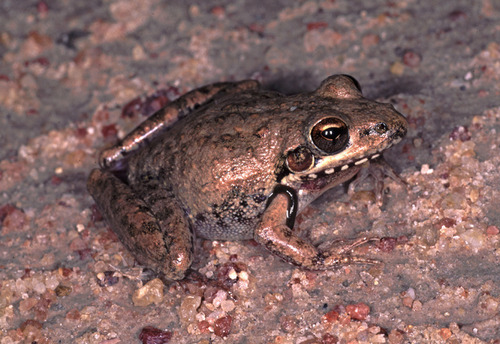
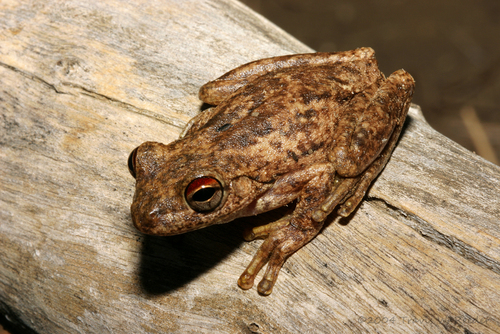
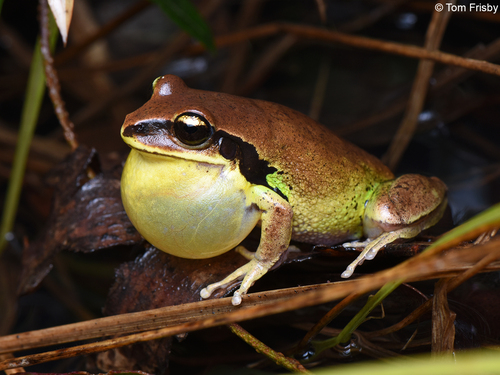
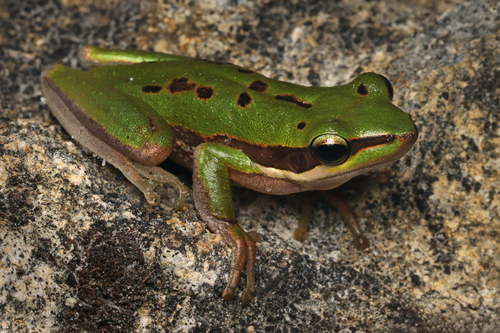
For the species Ranoidea alboguttata, adult females reach up to 85 millimetres (3.3 in) in length, while adult males grow to a maximum length of 70 millimetres (2.8 in). Its dorsal side is brown, olive, or green, marked with darker blotches. A pale yellow or yellow-green stripe typically runs down the back, and a dark streak extends from the snout, through the eye and tympanum, and breaks up over the flanks. A lateral skin fold sits above this dark streak. The backs of the thighs are dark, nearly black, with large white markings, and the throat and chest have scattered brown flecks. The dorsal skin has scattered warts and ridges. The belly has a granular texture, while the throat and chest are smooth. The toes are half webbed, and the tympanum is clearly defined. In terms of ecology and behaviour, Ranoidea alboguttata inhabits woodlands, grassy areas, and cleared areas. It is usually only found around temporary pools and water-filled claypans, and is active during both the day and night. This frog enters a state of torpor when resources are scarce. Researchers from the University of Queensland have found that the frog's cell metabolism changes during this dormancy period, letting it maximize the use of its limited energy resources without fully depleting them. This discovery may have important medical applications, especially in the study of obesity. For reproduction, males call from grassy edges around temporary pools and ditches. Their calls are often heard during the day, and the frogs are usually only spotted after heavy summer rain. The call is a rapid "quacking" produced from the ground or shallow water. Eggs are laid in clumps near the water's edge.