About Rankinia diemensis (Gray, 1841)
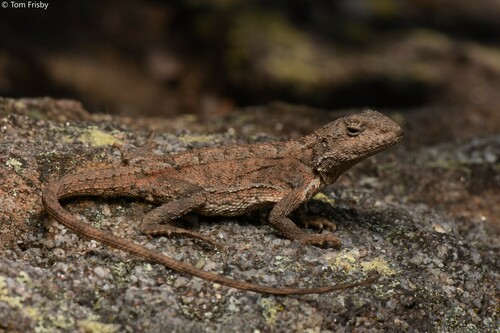
The overall body colour of Rankinia diemensis, commonly called the mountain dragon, ranges from grey to reddish brown. Two rows of lighter-coloured paravertebral stripes or blotches run down its back; these stripes are deeply scalloped, so they look like two separate series of blotches. Individuals may have cream-coloured bellies. Fully grown individuals can reach a total length of up to 20 cm, though the average total length is smaller, and females typically grow larger than males. The average snout-to-base-of-tail length is 7.5 centimeters, and can reach up to 9 centimeters. The species has a row of enlarged, spinose (spiky) scales on each side of the tail base. The mountain dragon is similar in appearance to the jacky dragon, but it is often much redder, and the inside of its mouth is pink, while the inside of a jacky dragon's mouth is yellow. Mountain dragons breed in summer, laying 2 to 9 eggs in a burrow. This species occurs in the uplands of New South Wales and Victoria in Australia, as well as in Tasmania, where it is the only native agamid lizard. It inhabits dry woodlands and heaths that have access to open areas for sunning. It is oviparous, and feeds on ants and other small invertebrates. It does not climb very high, and instead relies on camouflage to evade predators.