About Ranitomeya reticulata (Boulenger, 1884)
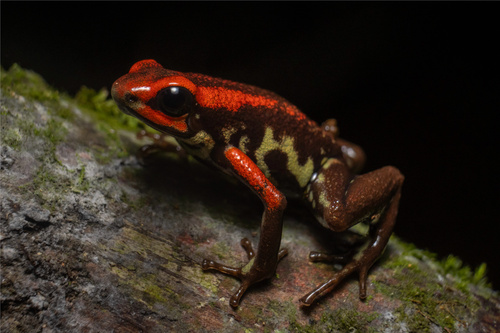
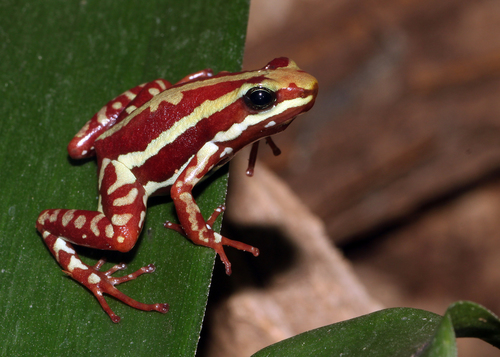
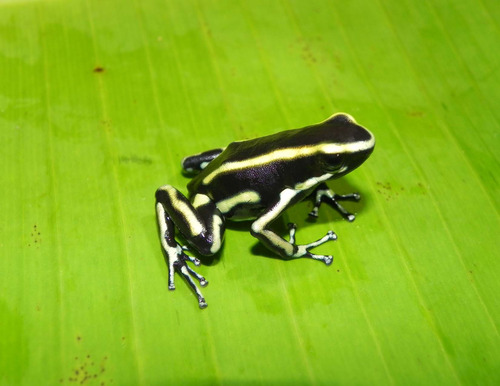
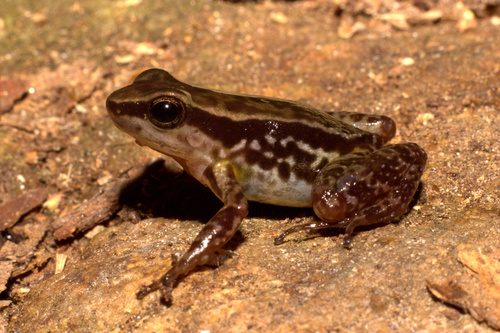
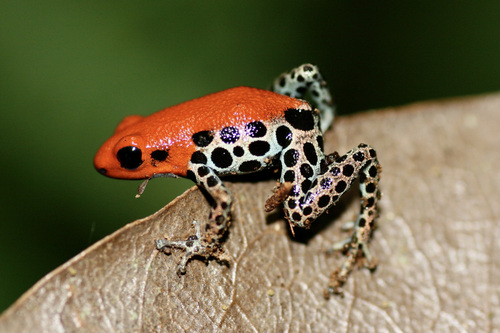
Ranatomyera reticulata, also known as the red-backed poison frog, is a species of dendrobatid poison frog. Adult males measure 13.0 to 15.0 mm in snout-vent length, while adult females measure approximately 14.0 to 17.0 mm. The dorsal surfaces of the head and body are metallic red or red-brown, and some individuals have black spots. The tops of the four legs, flanks, and belly are gray or blue-gray with black reticulation. This species has a slimmer build than many other dendrobatids. Combined with its very small size, this build allows it to squeeze into extremely small hiding places. Because of its small size, this frog often attempts to avoid predators by advertising its poison through its bright coloration or by climbing up trees to escape. If it cannot escape, it will use its poison as a defensive mechanism. This frog inhabits primary and secondary rainforests, and has been observed at elevations between 150 and 340 meters above sea level. In their natural habitat, R. reticulata live in small groups of five or six individuals. At the end of the wet season, multiple of these groups gather together in large breeding congregations. Like other poison dart frogs, males court females by calling to get their attention, then gently stroking and licking the female. A female signals that she is receptive to mating by stamping her hind feet, after which the pair mates. Breeding starting at the end of the wet season ensures eggs are laid at the start of the next wet season, so young frogs have a steady supply of water to survive. The female lays her eggs on the ground. After the eggs hatch, the male carries the tadpoles up into the forest canopy. Tadpoles produce water-soluble adhesive mucus that helps them stick to their father's back. The male deposits each tadpole into a tiny pool of water that collects in the center of a bromeliad plant. The female then feeds the tadpoles by laying infertile eggs into the pool water. Once tadpoles metamorphose into froglets, their parents lead them to an existing group of red-backed poison frogs. All group members accept the young froglets, but only the froglets' parents provide care for them. The red-backed poison frog is a moderately toxic dendrobatid, and is the second most poisonous species in the genus Ranitomeya. Its toxins act as a natural defense, making it inedible for most, if not all, predators in its native range. To advertise its poison and further reduce the risk of attack, the frog displays its bright warning coloration, especially its red-orange back, which gives the species its common name. Like all dendrobatids, this frog does not produce its own poison. Scientists theorize that it obtains toxins from the ants, mites, and beetles it feeds on. The frog absorbs the insects' toxins into its body, and it is immune to the poison. The poison is stored in skin glands just beneath the frog's outer skin layer. The poison can seep through open wounds, body orifices, and is believed to also seep through the skin's pores. This defense is especially effective against mammalian and avian predators, and less effective against reptilian predators. Amazonian ground snakes have limited resistance to the frog's poison, and will occasionally attack these frogs.