About Rangifer tarandus (Linnaeus, 1758)
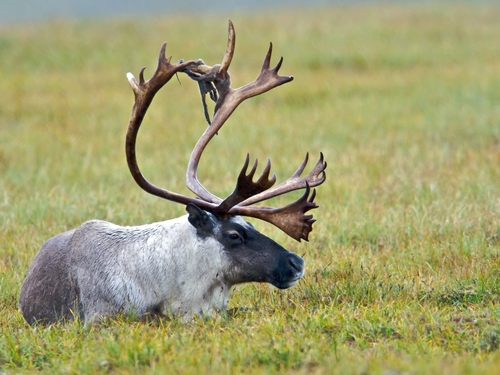
Scientific names and common names used here follow international taxonomic conventions predating recent revisions, as noted in the Reindeer taxonomy section. Reindeer, also called caribou, of the genus Rangifer, vary in size from the smallest Svalbard reindeer (R. (t.) platyrhynchus) to the largest Osborn's caribou (R. t. osborni). They also vary in coat color and antler structure. In North America, caribou range from Alaska through Yukon, the Northwest Territories, and Nunavut across tundra, taiga (boreal forest), and extend south through the Canadian Rocky Mountains. Of the eight subspecies Harding (2022) classifies within Arctic caribou (R. arcticus), several have distinct ranges and habitats: the migratory mainland barren-ground caribou of Arctic Alaska and northern Canada (R. t. arcticus) spends summers in tundra and winters in taiga, a transitional forest zone between boreal forest and tundra; the nomadic Peary caribou (R. t. pearyi) lives in the polar desert of the high Arctic Archipelago; Grant's caribou (R. t. granti, also called Porcupine caribou) lives on the western end of the Alaska Peninsula and its adjacent islands. The remaining four subspecies are all montane: Osborn's caribou (R. t. osborni), Stone's caribou (R. t. stonei), the Rocky Mountain caribou (R. t. fortidens), and the Selkirk Mountains caribou (R. t. montanus). The extinct insular Queen Charlotte Islands caribou (R. t. dawsoni) once lived on Graham Island in Haida Gwaii, which was formerly called the Queen Charlotte Islands. Boreal woodland caribou (R. t. caribou) lives in the boreal forest of northeastern Canada. Genetic studies confirm that the Labrador or Ungava caribou of northern Quebec and northern Labrador (R. t. caboti), and the Newfoundland caribou of Newfoundland (R. t. terranovae) fall within the woodland caribou lineage. In Eurasia, both wild and domestic reindeer are distributed across tundra and extend into taiga. Eurasian mountain reindeer (R. t. tarandus) are genetically and visually similar to North American caribou, but have enough differences to be classified as a separate species. The unique insular Svalbard reindeer inhabits the Svalbard Archipelago. The Finnish forest reindeer (R. t. fennicus) has a patchy distribution across coniferous forest zones from Finland to east of Lake Baikal. The Siberian forest reindeer (R. t. valentinae, formerly called the Busk Mountains reindeer (R. t. buskensis) by American taxonomists) occupies the Altai and Ural Mountains. Both male (called bulls) and female (called cows) reindeer grow new antlers each year, though the share of females that grow antlers varies widely between populations. Antlers are typically larger in males. Antler architecture varies by species and subspecies, and when paired with differences in fur, can often be used to distinguish between species and subspecies, with relevant illustrations available in Geist, 1991 and Geist, 1998. Naming in this section and all following sections follows the taxonomy from the authoritative 2011 reference work Handbook of the Mammals of the World Vol. 2: Hoofed Mammals. Some populations of North American caribou, such as many herds of the barren-ground caribou subspecies and some woodland caribou in Ungava and northern Labrador, complete the longest migrations of any terrestrial mammal, traveling up to 5,000 km (3,000 mi) per year, and covering a total area of 1,000,000 km² (400,000 sq mi). Other North American populations, for example boreal woodland caribou, are largely sedentary. European populations are known to have shorter migrations. Island populations including the Novaya Zemlya and Svalbard reindeer and the Peary caribou only make local movements within and between islands. Migrating reindeer can be negatively impacted by parasite loads. Severely infected individuals are weak and likely have shorter lifespans, but parasite levels vary between populations. Infections cause an effect called culling: infected migrating animals are less likely to finish their migration. When migrating, reindeer normally travel 19–55 km (12–34 mi) per day, and can run at speeds of 60–80 km/h (37–50 mph). Young calves can already outrun an Olympic sprinter when only one day old. During spring migration, smaller herds join together to form larger herds of 50,000 to 500,000 animals. During autumn migration, groups become smaller, and reindeer begin to mate. In winter, reindeer travel to forested areas to forage under the snow. By spring, groups leave their winter grounds to travel to calving grounds. Reindeer can swim easily and quickly, normally at about 6.5 km/h (4.0 mph), but can reach 10 km/h (6.2 mph) when necessary. Migrating herds will readily swim across large lakes or broad rivers. Barren-ground caribou form large herds and complete long seasonal migrations from winter feeding grounds in taiga to spring calving grounds and summer range in tundra. The migrations of the Porcupine herd of barren-ground caribou are among the longest of any mammal. Greenland caribou, found in southwestern Greenland, are "mixed migrators"; many individuals do not migrate, and those that do travel less than 60 km. Unlike barren-ground caribou, which have an individual-tending mating system, aggregated rutting, synchronized calving, and aggregated post-calving grouping, Greenland caribou have a harem-defense mating system, dispersed calving, and do not aggregate. Although most wild tundra reindeer migrate between winter range in taiga and summer range in tundra, some ecotypes or herds are more or less sedentary. Novaya Zemlya reindeer (R. t. pearsoni) formerly wintered on the mainland and migrated across ice to the islands for summer, but only a small number still migrate today. Finnish forest reindeer (R. t. fennicus) were formerly distributed across most of the coniferous forest zones south of the tree line, including some mountains, but now have a patchy distribution within this zone. As an adaptation to their Arctic environment, reindeer have lost their circadian rhythm. Originally, reindeer were found across Scandinavia, Eastern Europe, Greenland, Russia, Mongolia, and northern China north of the 50th parallel. In North America, they were found in Canada, Alaska, and the northern contiguous United States from Maine to Washington. In the 19th century, they were still present in southern Idaho. Even in historical times, reindeer likely occurred naturally in Ireland, and are believed to have lived in Scotland until the 12th century, when the last reindeer were hunted in Orkney. During the Late Pleistocene Epoch, reindeer ranged much further south in North America, reaching as far south as Nevada, Tennessee, and Alabama, and as far south as Spain in Europe. Though their range retreated northwards during the terminal Pleistocene, reindeer returned to Northern Europe during the Younger Dryas. Today, wild reindeer have disappeared from these southern areas, and have vanished from almost all of the southern parts of their original range. Large populations of wild reindeer are still found in Norway, Finland, Siberia, Greenland, Alaska, and Canada. According to Grubb (2005), Rangifer is "circumboreal in the tundra and taiga", found from "Svalbard, Norway, Finland, Russia, Alaska (USA) and Canada including most Arctic islands, and Greenland, south to northern Mongolia, China (Inner Mongolia), Sakhalin Island, and USA (northern Idaho and Great Lakes region)." Reindeer were introduced to Iceland, the Kerguelen Islands, South Georgia Island, the Pribilof Islands, and St. Matthew Island, where they are now feral; a free-ranging semi-domesticated herd also exists in Scotland. There is strong regional variation in Rangifer herd size. There are large population differences between individual herds, and individual herd sizes have changed greatly since 1970. The largest herd, located in Taimyr, Russia, has varied in size between 400,000 and 1,000,000 individuals. The second largest herd, at the George River in Canada, has varied between 28,000 and 385,000. While the genus Rangifer is widespread and numerous across the northern Holarctic, present in both tundra and taiga (boreal forest), by 2013 many herds had "unusually low numbers", and their winter ranges in particular were smaller than they had been previously. Caribou and reindeer numbers have fluctuated throughout history, but many herds are declining across their entire range. This global decline is linked to climate change for northern migratory herds, and to industrial habitat disturbance for non-migratory herds. Barren-ground caribou are particularly vulnerable to the effects of climate change, due to a phenological mismatch between food availability during the calving period. In November 2016, it was reported that more than 81,000 reindeer in Russia died as a result of climate change. Longer autumns led to increased freezing rain, which formed a layer of ice a few inches thick over lichen, causing many reindeer to starve to death. Reindeer mate between late September and early November, with a gestation period of about 228–234 days. During the mating season, bulls fight for access to cows. Two bulls will lock their antlers together and attempt to push each other away. The most dominant bulls can gather 15–20 cows to mate with. Bulls stop eating during the mating season and lose much of their stored body fat. To give birth, females travel to isolated, relatively predator-free areas such as islands in lakes, peatlands, lake shores, or tundra. Because females select habitat to give birth to their calves, they are warier than males. Dugmore noted that for this reason, the herd follows a female during seasonal migrations. Newborn calves weigh an average of 6 kg (13 lb). Calves are born in May or June. After 45 days, calves are able to graze and forage on their own, but continue suckling until the following autumn when they become independent from their mothers. Bulls live an average of four years less than cows, and cows have a maximum lifespan of about 17 years. Cows with normal body size and sufficient summer nutrition can begin breeding between 1 and 3 years of age. If a cow experiences nutritional stress, she may not reproduce at all that year. Dominant bulls, which have larger body size and larger antler racks, inseminate more than one cow per mating season.