About Randia moorei F.Muell. ex Benth.
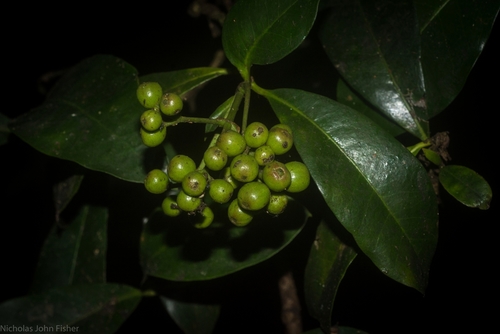
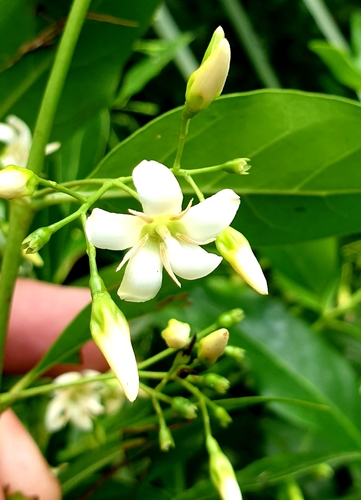
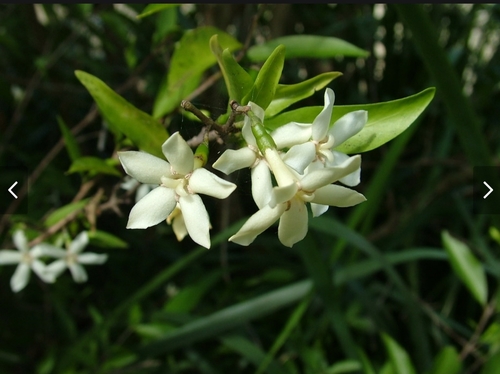
Randia moorei, commonly known as the spiny gardenia, is a rare Australian shrub. It grows in far northeastern New South Wales and adjacent areas of Queensland, with its habitat being subtropical rainforest north of Lismore. It is found on basalt soils ranging from Lismore in northern New South Wales north into the Gold Coast Hinterland, growing as an understory plant in subtropical dry rainforest under hoop pine (Araucaria cunninghamii) and brush box (Lophostemon confertus), often along watercourses. Much of its habitat has been cleared for urban and agricultural development, including banana plantations, as well as clearing for the upgrading of the Pacific Highway. The spiny gardenia also resembles Cockspur Vine (Maclura cochinchinensis) and invasive small-leaved privet (Ligustrum sinense), so accidental inadvertent removal can occur. Randia moorei was described by George Bentham in his Flora Australiensis in 1867, and is one of many plants named to honor Charles Moore. Unlike several other Australian species, it was not transferred to the genus Atractocarpus. It remains in the genus Randia, which was historically a wastebasket taxon, for the time being. New South Wales botanist Gwen Harden classified this species in the genus Xeromphis. Randia moorei grows as a shrub or small tree, reaching 8 m (25 ft) in height. Its roots can form suckers when disturbed. Spines are often present on its stems. The leaves are broadly oval with a narrow tip, measuring 2–6 cm (0.8–2.4 in) in length and 1–3 cm (0.4–1.4 in) in width. The fragrant flowers grow in groups of three at the tips or along the sides of branchlets, and are followed by a round golden berry that measures 0.6–0.9 cm long.