About Rana temporaria Linnaeus, 1758
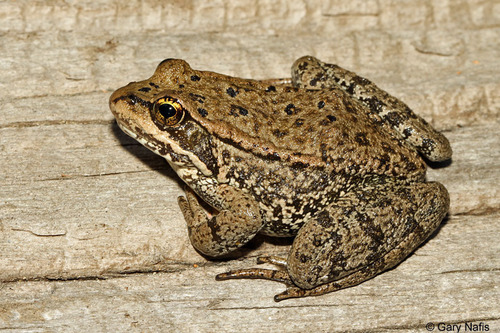
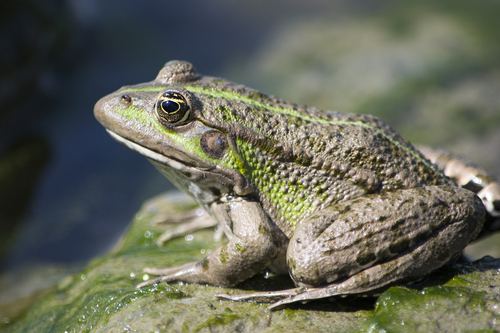
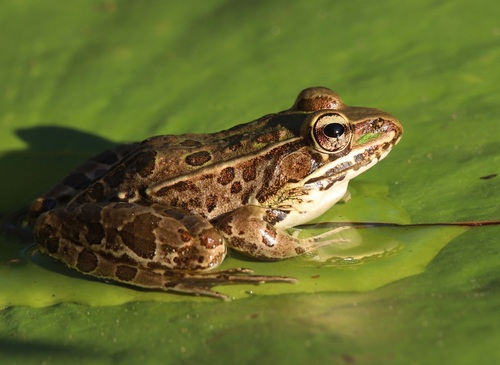
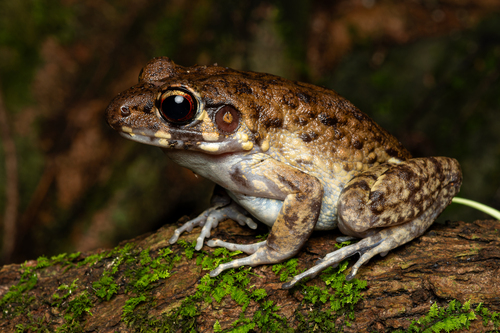
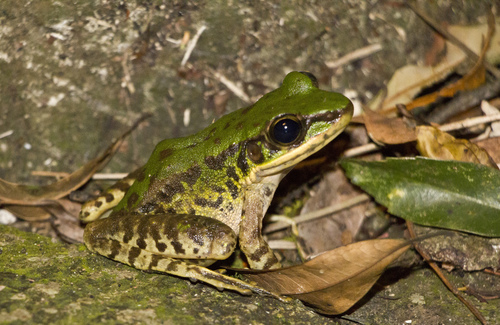
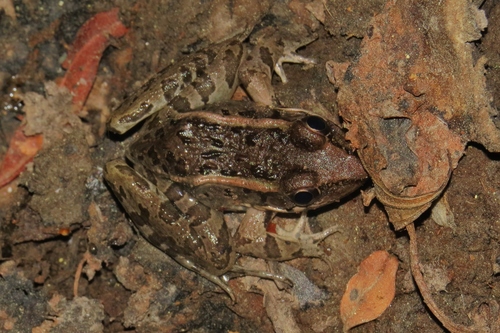
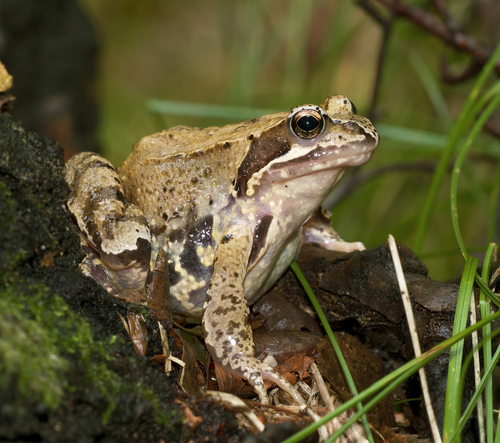
Adult common frogs (Rana temporaria Linnaeus, 1758) have a body length of 6 to 9 centimetres (2.4 to 3.5 in), with an average mass of 22.7 g (0.80 oz). Females are usually slightly larger than males. Their back and flanks range in color from olive green, grey-brown, brown, olive brown, grey, yellowish to rufous, and they can lighten or darken their skin to match their surroundings. Some individuals have rare color morphs: black and red individuals have been recorded in Scotland, while albino frogs have yellow skin and red eyes. During the mating season, males usually turn greyish-blue. Irregular dark blotches cover their flanks, limbs and backs; they typically have a chevron-shaped spot on the back of the neck and a dark spot behind the eye. Unlike many other amphibians, common frogs generally do not have a mid-dorsal band, and any present is quite faint. This distinguishes them from moor frogs, which have a distinct light dorsal band. The common frog's underbelly is white or yellow, occasionally more orange in females, and may be speckled with brown or orange. Their eyes are brown with transparent horizontal pupils; they have transparent inner eyelids to protect the eyes underwater, as well as a dark 'mask' covering the eyes and eardrums. Compared to the common toad, the common frog has longer hind legs, but its hind legs are shorter than those of the agile frog, which shares part of the common frog's range. The agile frog's longer hind legs and fainter coloration are the main features that separate the two species. Males can be told apart from females by their smaller size and hard swellings called nuptial pads on the first digits of their forelimbs, which are used to grip females during mating. During the mating season, males often have white throats and an overall light grey body, while females are browner or even red. Common frogs have smooth skin; some sources note they reach an average weight of 22.7 grams and length of 7 to 10 centimetres (2.8-3.9 in), with coloration ranging from gray to green, brown, yellow, or red, often covered in blotches, and a white or yellow underside that is frequently spotted. Outside of the breeding season, common frogs live solitary lives in damp wetland habitats near ponds or marshes, or among tall riparian grass. They are active for most of the year, only hibernating during the coldest months. At the northernmost edges of their range, they may be trapped under ice for up to nine months a year, but recent studies show they can remain relatively active at temperatures near freezing. In the British Isles, they typically hibernate from late October to January, and can re-emerge as early as February if conditions are suitable to migrate to bodies of water such as garden ponds to spawn. In harsher climates like the Alps, they may emerge as late as early June. Common frogs hibernate in running waters, muddy burrows, or layers of decaying leaves and mud at the bottom of flowing ponds or lakes. Skin oxygen uptake is enough to meet the needs of cold, inactive frogs during hibernation. The common frog is found across most of Europe, ranging north into northern Scandinavia inside the Arctic Circle and east to the Urals. It is absent from most of Iberia, southern Italy, and the southern Balkans. It has been introduced to the Isle of Lewis, Shetland, Orkney and the Faroe Islands. It also occurs in Asia, ranging eastward to Japan. The common frog was long considered a fully introduced species in Ireland, but genetic analysis indicates that some populations in southwestern Ireland are native to the island. Researchers propose the Irish common frog population is mixed, consisting of native frogs that survived the last glacial period in ice-free refugia, natural post-glacial colonizers, and recent artificial introductions from Western Europe. In spring, changes to external factors including rainfall, day length and temperature stimulate the frog's pituitary gland to produce hormones that trigger the production of sex cells: eggs in females and sperm in males. Males' nuptial pads also swell and become darker in color. Common frogs breed in shallow, still, fresh water such as ponds, with spawning occurring between late February and late June, typically in April across most of their range. Female common frogs lay between a few hundred and 5,000 eggs per clutch. Most eggs form large aggregations that help with thermoregulation and protect developing embryos from predators. Egg aggregation raises the temperature surrounding embryos compared to the surrounding water, which speeds up tadpole development. Females usually lay eggs in shallow areas of the pond to avoid hypoxia-related embryo death. Eggs generally take 2–3 weeks to hatch. After hatching, tadpoles group together in schools, which helps them feed on algae and larger plants and avoid predators. Most tadpoles complete metamorphosis by June and July, and the remaining time before winter is spent feeding and growing. Only the largest individuals survive winter, so rapid development before winter is critical. A common frog's development rate correlates with temperature: common frogs in lower temperature regions hatch and complete metamorphosis earlier than common frogs in warmer climate regions. Common frogs reach sexual maturity after three years, and typically live between six and eight years.