About Rana sierrae Camp, 1917
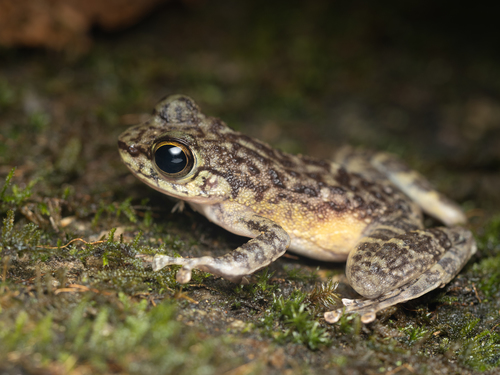
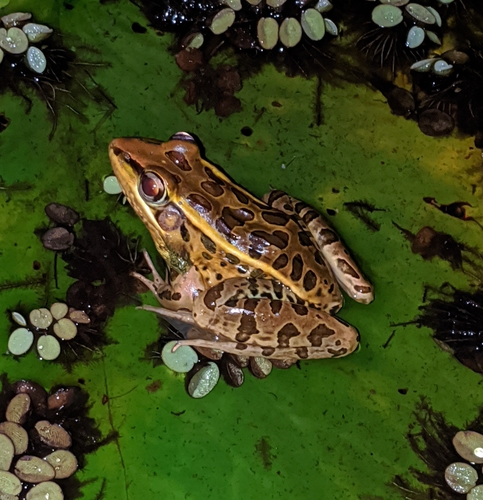
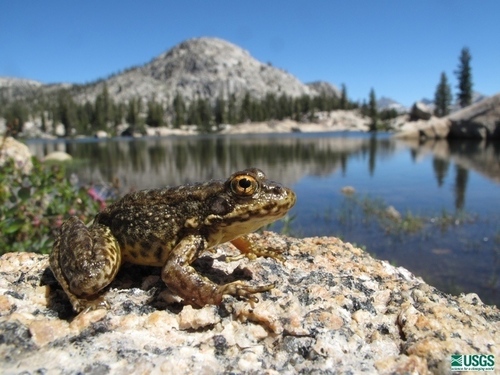
The Sierra Nevada yellow-legged frog, scientifically named Rana sierrae Camp, 1917, is one of two species that form the "mountain yellow-legged frog species complex," alongside the southern mountain yellow-legged frog Rana muscosa. It looks extremely similar to the southern mountain yellow-legged frog; the two were split into separate species after analysis of mitochondrial DNA, plus identification of subtle differences in body structure and breeding calls. R. sierrae is highly aquatic, and individuals are normally found within a few meters of water. The upper body of these frogs is often olive, brownish, or yellowish, with variable amounts of black or brown markings that frequently take the form of dark spots or bands. Much of the ventral side, including the chin, can have yellow or light orange coloration. This color is most commonly seen on the underside of the legs, lower abdomen, and groin, and sometimes extends up onto the flanks, though not all individuals have distinct ventral yellow coloring. R. sierrae tadpoles are black or brown. They measure around one centimeter shortly after hatching, and grow to approximately 75 millimeters in total length before metamorphosis. Metamorphosis may take several years for populations at higher elevations. Females generally reach a maximum snout vent length (SVL) of 3.4 inches (87 mm), while males reach a maximum SVL of around 2.7 inches (68 mm). R. sierrae does not have prominent vocal sacs, but it still vocalizes, producing short, muffled croaks, groans, and squawks. R. sierrae hibernates underwater during winter, staying submerged in and around lakes, ponds, and deep stream pools. At the highest elevation populations, R. sierrae may only be active for around three months each year, depending on climatic conditions, while lower elevation populations are often active for at least six months annually. When disturbed, R. sierrae can produce skin secretions with a musky, garlic-like odor. R. sierrae lives in lakes, ponds, streams, flooded meadows, and other wetland habitats, at elevations ranging from roughly 4,500 feet to 12,000 feet. The species spends most of its life in or near these water sources, which provide foraging, breeding, and overwintering habitat. It is found primarily from Kings Canyon National Park and surrounding National Forest lands north through Plumas County in the northern Sierra Nevada. While overall population densities of R. sierrae have declined compared to their historic distribution, especially at the northern extent of the species' range, the species is showing positive signs of recovery in some locations. Adult frogs can be found basking on aquatic habitat features like rocks, logs, and shorelines; resting near shore with their head protruding from shallow water; hiding in locations such as crevices, beneath undercut banks, under overhanging logs, and within low shoreline vegetation; or sitting on the bottom of lakes and streams. Larvae often congregate, sometimes in dense clusters in larger populations, in warm, shallow areas of water. Breeding for R. sierrae typically begins soon after snowmelt in spring or early summer, though timing varies based on elevation, water year, and local site conditions, usually falling between April and August. During the breeding season, adult male frogs call to attract mates, usually while in or underwater. When a female arrives, the male grasps the female's back in the mating position called amplexus, and externally fertilizes eggs as the female releases them. Eggs are laid in masses underwater, often attached to rocks, submerged vegetation, or beneath undercut banks. Eggs are typically laid in fishless habitats where water is deep enough that it does not freeze completely over winter; overwinter mortality caused by freezing of shallow habitats and anoxic conditions has been recorded. Egg masses contain an estimated 100 to 350 eggs. Eggs hatch after approximately 15 to 20 days. Larvae develop into adult frogs over a period of one to four years, depending on elevation, weather, and local conditions.